
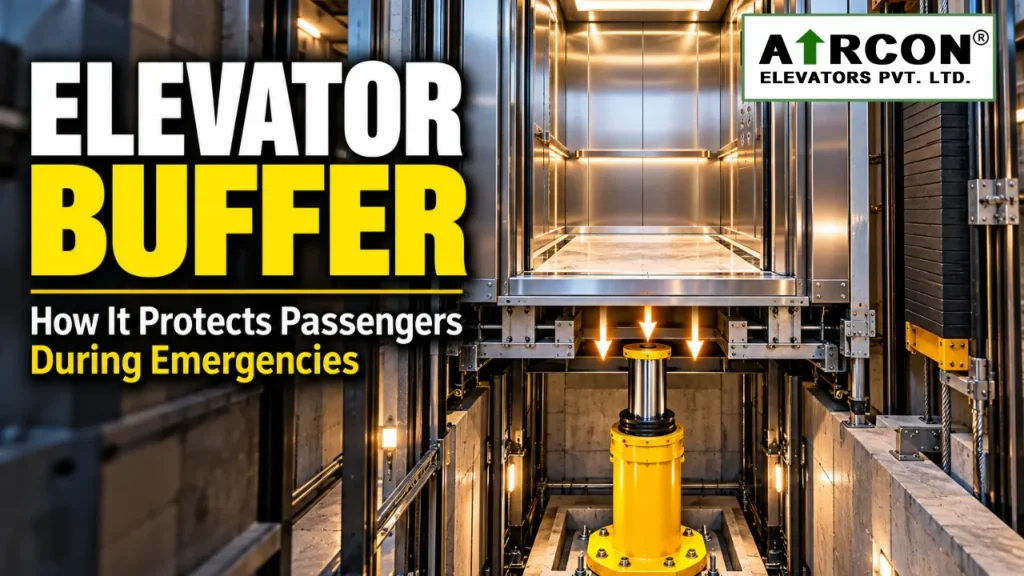
An Elevator Buffer is the final line of defense in a modern elevator safety system, designed to absorb impact energy if the elevator cabin or counterweight travels beyond its normal stopping position. But what exactly does an Elevator Buffer do? and why is it so important for passenger safety?
The answer is the Elevator Buffer.
An Elevator Buffer is one of the most important passive safety components in an elevator system. Although passengers rarely see it, this device serves as the final line of defense by absorbing impact energy if the elevator cabin or counterweight travels beyond its designated stopping point.
Modern elevators rely on multiple safety systems including governors, safety gears, brakes, and controllers to prevent dangerous situations. However, if all these systems fail to stop the elevator before it reaches the end of its travel, the Buffer helps reduce the impact force and protects both passengers and critical elevator components.
Whether you’re a building owner, architect, engineering student, facility manager, or simply curious about how elevators work, understanding the purpose of a Buffer will give you a better appreciation of modern elevator safety.
What Is an Elevator Buffer?
Manufacturers install an Elevator Buffer at the bottom of the elevator shaft (pit) as a specialized safety device. Its primary function is to absorb and dissipate the impact energy if the elevator cabin or counterweight travels beyond its normal stopping position.
Instead, the lift Buffer cushions the impact and gradually slows the moving mass before the cabin can strike the pit floor directly. This significantly reduces the stress on the elevator structure and helps protect passengers, equipment, and the building itself.
Additionally, manufacturers use different types of buffers depending on the elevator’s speed, capacity, and intended application. Low-speed elevators often use spring buffers, while medium- and high-speed elevators typically rely on hydraulic buffers because of their superior energy absorption capabilities.
Even though an Elevator Buffer is rarely activated during normal operation, it remains an essential part of every modern elevator safety system.
Why Is an Elevator Buffer Important?
Most importantly, the Elevator Buffer plays a critical role in ensuring passenger safety and protecting expensive elevator equipment.
While modern elevators include numerous safety devices that prevent uncontrolled movement, engineers design every elevator with multiple layers of protection. The Buffer acts as the final safeguard if the cabin or counterweight reaches the end of the shaft unexpectedly.
Some key reasons why a Buffer is important include:
- Absorbs impact energy during an emergency.
- Reduces the force transmitted to the elevator cabin and counterweight.
- Helps minimize structural damage inside the elevator shaft.
- Protects guide rails and other critical mechanical components.
- Supports compliance with international elevator safety standards.
- Improves overall elevator reliability and passenger safety.
Without a Buffer, even a low-speed impact could cause severe damage to elevator equipment and increase maintenance costs.
Where Is an Elevator Buffer Located?
The Buffer is installed inside the elevator pit at the very bottom of the elevator shaft.
Engineers design its exact position to protect either the elevator cabin or the counterweight.
Typically, an elevator system includes:
- Cabin Buffer installed directly beneath the elevator cabin.
- Counterweight Buffer positioned beneath the counterweight travel path.
When the elevator reaches its lowest possible travel limit, the buffer remains ready to absorb any unexpected impact before the cabin or counterweight contacts the pit floor.
Because the lift Buffer is installed inside the pit, it is normally visible only during maintenance or inspection procedures performed by qualified elevator technicians.
How Does an Elevator Buffer Work?
Understanding how an Elevator Buffer works is surprisingly simple.
During normal elevator operation, the cabin never touches the buffer. The elevator controller, braking system, and limit switches ensure the cabin stops safely at the correct floor.
However, in an abnormal situation where the cabin continues moving beyond its intended travel limit, the lift Buffer becomes active.
The process typically works like this:
Step 1: Elevator Moves Beyond Normal Travel
Due to an unexpected fault, maintenance testing, or emergency condition, the elevator travels beyond its normal stopping position.
Step 2: Elevator Buffer Makes Contact
The bottom of the cabin (or counterweight) gently contacts the lift Buffer installed in the pit.
Step 3: Energy Absorption Begins
Instead of allowing an instant collision with the pit floor, the lift Buffer compresses or slows down using its internal mechanism.
Depending on the buffer type, this may involve:
- Spring compression
- Hydraulic oil displacement
- Energy dissipation through controlled resistance
Step 4: Impact Force Is Reduced
As the Elevator Buffer absorbs kinetic energy, the stopping force is spread over a longer distance and time.
This controlled deceleration greatly reduces mechanical stress on the elevator system.
Step 5: Equipment Protection
By reducing impact forces, the Buffer helps protect:
- Elevator cabin
- Counterweight
- Guide rails
- Suspension system
- Elevator frame
- Shaft structure
This layered safety approach makes modern elevators significantly safer than earlier generations.
Main Components of an Elevator Buffer
Although different manufacturers use different designs, most lift Buffers include several common components.
Buffer Housing
The outer body provides structural support and securely anchors the buffer inside the lift pit.
Energy Absorption Mechanism
This is the core component responsible for absorbing impact energy.
Depending on the buffer type, it may use:
- Steel springs
- Hydraulic cylinders
- Oil chambers
- Pistons
Mounting Base
A heavy-duty base plate fixes the Elevator Buffer securely to the pit floor, preventing movement during impact.
Guide Components
Some hydraulic Elevator Buffers include guide rods or pistons that ensure smooth compression and controlled energy absorption.
Types of Elevator Buffer
Different elevator applications require different types of Buffers. The choice depends mainly on elevator speed, travel height, and load capacity.
1. Spring Elevator Buffer
The Spring Buffer is commonly used in low-speed elevators.
When the cabin contacts the buffer, heavy-duty steel springs compress and absorb part of the impact energy before returning to their original position.
Advantages
- Simple design
- Low maintenance
- Cost-effective
- Reliable for low-speed applications
Limitations
- Limited energy absorption
- Not suitable for high-speed elevators
- Produces higher rebound after compression
Because of these limitations, spring buffers are generally used only in slower elevator systems.
2. Hydraulic Elevator Buffer
The Hydraulic lift Buffer is the most common type used in modern passenger and commercial elevators.
Instead of relying on spring compression alone, hydraulic buffers use specially designed cylinders filled with hydraulic oil.
When the elevator contacts the buffer, a piston moves through the oil chamber. The hydraulic fluid creates controlled resistance, allowing the cabin to slow down smoothly rather than stopping abruptly.
Advantages
- Excellent energy absorption
- Smooth deceleration
- Suitable for medium- and high-speed elevators
- Reduced mechanical stress
- Improved passenger protection
Because of their superior performance, Hydraulic Elevator Buffers are widely used in high-rise buildings and commercial elevator installations.
3. Polyurethane Elevator Buffer
Some specialized elevator applications use Polyurethane Elevator Buffers.
These buffers utilize high-density elastomer materials that deform under load and gradually absorb impact energy.
Although they are less common than hydraulic buffers, they can provide excellent durability in specific industrial or customized elevator systems.
Advantages
- Corrosion resistant
- Minimal maintenance
- Long service life
- Consistent performance under repeated compression
Which Elevator Buffer Is Used in Modern Elevators?
Today, most modern passenger elevators, commercial lifts, hospital elevators, and high-rise building elevators use Hydraulic Elevator Buffers.
Their ability to absorb large amounts of impact energy while providing smooth deceleration makes them the preferred choice for modern elevator manufacturers.
Manufacturers still use Spring Elevator Buffers in certain low-speed applications, while polyurethane buffers are selected for specialized installations where specific performance characteristics are required.
Hydraulic technology continues to dominate because it offers an excellent balance of safety, durability, reliability, and compliance with modern elevator standards.
When Does an Elevator Buffer Activate?
One of the biggest misconceptions is that an Elevator Buffer works every time an elevator stops. In reality, Engineers design the Elevator Buffer only for emergency or abnormal situations, and it never contacts the elevator during normal operation.
Modern elevators use controllers, limit switches, braking systems, and safety gears to stop the cabin accurately at each floor. The Elevator Buffer remains inactive unless the elevator travels beyond its intended stopping position.
Some situations where an Elevator Buffer may activate include:
- Failure of the main braking system
- Elevator overshooting the lowest landing
- Maintenance or safety testing
- Controller malfunction
- Emergency inspection procedures
- Rare mechanical failures
Because multiple safety systems operate before the Elevator Buffer, its activation is extremely uncommon in properly maintained elevators.
Elevator Buffer vs Safety Gear
Many people confuse the Elevator Buffer with the Safety Gear, but these two components perform completely different functions.
The Safety Gear is installed underneath the elevator cabin and is designed to grip the guide rails if the elevator moves at an unsafe speed.
The lift Buffer, on the other hand, is fixed at the bottom of the lift pit. Its purpose is to absorb impact energy if the cabin or counterweight reaches the end of its travel.
Safety Gear
- Mounted beneath the elevator cabin
- Activated during overspeed conditions
- Grips the guide rails
- Stops the moving cabin before it reaches the pit
Lift Buffer
- Installed inside the elevator pit
- Activated only at the end of travel
- Absorbs remaining kinetic energy
- Protects the cabin, counterweight, and shaft structure
Both systems work together as part of a layered elevator safety design, ensuring maximum passenger protection.
Cabin Elevator Buffer vs Counterweight Elevator Buffer
Most modern elevators use two different Elevator Buffers.
Cabin Elevator Buffer
The cabin buffer is positioned directly below the lift cabin.
If the cabin travels beyond its lowest permitted position, it contacts this lift Buffer first.
The buffer absorbs the remaining impact energy and prevents direct contact with the pit floor.
Counterweight Elevator Buffer
The counterweight also travels inside the shaft and therefore requires its own protection.
A dedicated counterweight lift Buffer is installed beneath the counterweight path.
Its purpose is to absorb impact if the counterweight reaches the end of its travel unexpectedly.
Both buffers are equally important because damage to either side of the elevator system can affect safe operation.
Elevator Buffer Inspection and Maintenance
Like every other elevator safety component, an Elevator Buffer requires periodic inspection.
Although the buffer is rarely activated, environmental conditions such as dust, moisture, corrosion, and aging can gradually reduce its effectiveness.
Routine maintenance helps ensure the lift Buffer remains ready for emergency situations.
During inspection, technicians typically check:
- Physical condition of the buffer
- Proper mounting and alignment
- Corrosion or rust
- Hydraulic oil leakage (for hydraulic buffers)
- Spring condition (for spring buffers)
- Damage caused by previous impacts
- Manufacturer’s service recommendations
Regular inspections also help identify small issues before they become costly repairs.
Common Elevator Buffer Problems
Although Elevator Buffers are built for long-term reliability, they can develop problems over time if they are not maintained properly.
Some common issues include:
Hydraulic Oil Leakage
Hydraulic Elevator Buffers rely on oil to absorb impact energy.
Oil leakage reduces damping performance and may require immediate servicing.
Corrosion
Moisture inside the elevator pit can cause rust on metal components.
Excessive corrosion weakens structural integrity and shortens service life.
Worn Internal Components
After many years of operation, seals, pistons, springs, or other internal parts may wear out and reduce the buffer’s performance.
Misalignment
If the Buffer shifts from its correct position, it may not align properly with the cabin or counterweight during an emergency.
Physical Damage
Construction work, flooding, accidental impact, or improper maintenance may damage the lift Buffer housing.
Signs an Elevator Buffer May Need Replacement
Because Elevator Buffers remain inactive most of the time, problems can go unnoticed without proper inspection.
Building owners should ensure that qualified technicians investigate the following warning signs:
- Visible hydraulic oil leakage
- Heavy corrosion or rust
- Bent or damaged housing
- Loose mounting bolts
- Cracked welds
- Uneven compression
- Manufacturer-recommended replacement interval reached
- Damage discovered after an emergency impact
Replacing a worn lift Buffer before it fails is far safer and less expensive than repairing damage caused by an emergency.
Benefits of Proper Elevator Buffer Maintenance
Routine maintenance offers several important benefits for both passengers and building owners.
A properly maintained lift Buffer helps:
- Improve passenger safety
- Increase overall elevator reliability
- Extend equipment lifespan
- Reduce expensive repair costs
- Minimize unexpected downtime
- Support compliance with safety regulations
- Protect the elevator shaft structure
- Improve long-term maintenance efficiency
Preventive maintenance is always more economical than emergency repairs after equipment failure.
Elevator Buffer Safety Standards
Manufacturers must ensure modern Elevator Buffers comply with strict safety standards before installing them in commercial or residential buildings.
Depending on the country, manufacturers design Elevator Buffers to meet recognized standards such as:
- IS 14665 (India)
- EN 81 (Europe)
- ASME A17.1 / CSA B44 (United States & Canada)
- Local building regulations
- National elevator safety codes
These standards define important requirements such as:
- Buffer design
- Energy absorption capacity
- Installation methods
- Performance testing
- Maintenance procedures
- Periodic inspection requirements
Following these standards helps ensure that every lift Buffer performs reliably if it is ever required during an emergency.
How Elevator Buffer Fits Into the Overall Safety System
An Elevator Buffer is only one part of a complete elevator safety system.
Modern elevators use multiple independent safety devices that work together in sequence.
A typical safety chain includes:
- Intelligent Elevator Controller
- Door Interlock System
- Electromagnetic Braking System
- Overspeed Governor
- Safety Gear
- Limit Switches
- Automatic Rescue Device (ARD)
- Lift Buffer (Final Line of Defense)
This multi-layered approach ensures that even if one safety device fails, additional systems continue protecting passengers.
Common Myths About Elevator Buffer
Many people misunderstand the purpose of a Buffer because it is hidden inside the lift pit and rarely seen during normal operation. Let’s separate fact from fiction.
Myth 1: Elevator Buffers Stop the Elevator Every Time It Reaches the Ground Floor
False.
During normal operation, a lift never touches the lift Buffer. The controller and braking system stop the cabin accurately at each floor. The buffer is only intended for emergency or abnormal situations.
Myth 2: Every Elevator Uses the Same Type of Elevator Buffer
False.
Different elevators use different buffer types depending on their speed, travel height, and load capacity. Low-speed elevators often use spring buffers, while modern passenger elevators typically use hydraulic buffers.
Myth 3: Elevator Buffers Eliminate the Need for Other Safety Devices
False.
An Elevator Buffer is only one layer of protection. Modern elevators also rely on overspeed governors, safety gear, electromagnetic brakes, door interlocks, controllers, and limit switches to ensure passenger safety.
Myth 4: Elevator Buffers Require No Maintenance
False.
Although Elevator Buffers are rarely activated, they still require routine inspections to check for corrosion, oil leakage, damage, and proper alignment.
Frequently Asked Questions (FAQs)
A Buffer is a safety device installed at the bottom of the lift shaft. It absorbs impact energy if the elevator cabin or counterweight travels beyond its normal stopping position.
The lift Buffer is installed inside the pit beneath both the lift cabin and the counterweight travel path.
The Buffer absorbs kinetic energy through springs or hydraulic oil, allowing the lift to slow down gradually instead of experiencing a sudden impact.
Hydraulic Elevator Buffers are the most common choice for modern passenger and commercial elevators because they provide smooth deceleration and excellent energy absorption.
No. A lift Buffer is not designed to stop a falling lift. It acts as the final protective device if the cabin reaches the end of its travel. Other systems like the overspeed governor, safety gear, and braking system prevent uncontrolled movement.
Inspection intervals depend on local regulations and the manufacturer’s recommendations. During routine elevator maintenance, technicians inspect the Elevator Buffer for oil leaks, corrosion, alignment, and physical damage.
A damaged Elevator Buffer may not absorb impact energy correctly during an emergency. It should be repaired or replaced immediately by qualified elevator professionals.
Final Thoughts
Although passengers rarely see it, the Elevator Buffer plays a vital role in modern elevator safety. Installed at the bottom of the elevator shaft, it serves as the final protective device by absorbing impact energy if the cabin or counterweight travels beyond its intended stopping point.
Modern elevators combine multiple independent safety systems including controllers, overspeed governors, safety gear, brakes, and Automatic Rescue Devices to prevent dangerous situations. The Buffer complements these systems by reducing impact forces and protecting both passengers and expensive lift components during rare emergency conditions.
Whether you own a residential lift, manage a commercial building, or simply want to understand how elevators work, knowing the purpose of a Buffer highlights the advanced engineering that keeps modern vertical transportation safe and reliable.
Regular inspections, preventive maintenance, and compliance with recognized safety standards help keep Elevator Buffers ready whenever an emergency occurs.