
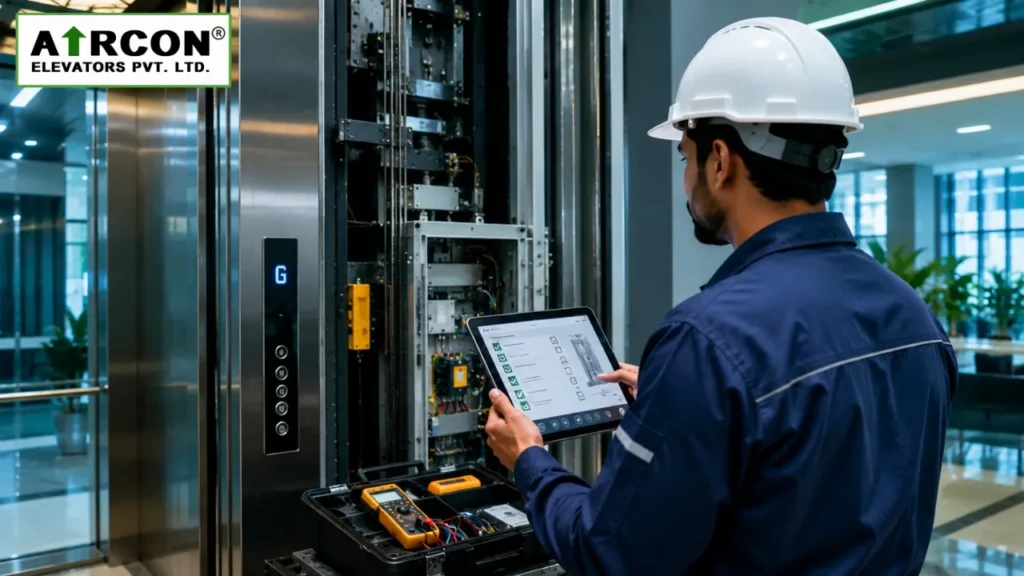
Elevators are among the most frequently used systems in residential towers, offices, hospitals, hotels and commercial buildings. Because passengers depend on them every day, elevator safety should never rely only on routine repairs after something goes wrong.
A proper safety program combines suitable equipment, regular maintenance, inspections, testing and compliance with applicable regulations.
For building owners, the challenge is understanding which standards apply, what an elevator safety audit should cover, and when professional inspection becomes necessary.
Why Elevator Safety Standards Matter
Modern elevators include multiple mechanical, electrical and electronic safety systems. These systems work together to control movement, monitor doors, manage stopping accuracy and respond to abnormal conditions.
In India, the Bureau of Indian Standards (BIS) maintains standards covering different aspects of lifts. For example, the IS 14665 series covers electric traction lifts, including installation, operation, maintenance, safety rules, components and inspection guidance. BIS also lists IS 15259 for installation and maintenance of home lifts.
Building owners should also understand that applicable statutory requirements can vary according to the location, building type and elevator application.
Key Elevator Safety Areas Every Owner Should Check
1. Door Safety and Interlocking
Elevator doors need reliable safety mechanisms because passengers enter and exit the cabin at every floor.
A professional inspection should examine:
- Door locks and interlocks
- Door sensors
- Door opening and closing operation
- Landing door condition
- Door protection systems
- Proper alignment
If doors reopen unexpectedly, make unusual sounds or fail to close correctly, arrange a professional inspection instead of repeatedly resetting the system.
2. Emergency and Rescue Systems
A building owner should know what happens if the power supply fails while passengers are inside the elevator.
Depending on the elevator design, emergency systems can include an Automatic Rescue Device (ARD), emergency lighting, alarm systems, communication equipment and other safety provisions.
During maintenance and testing, these systems should receive appropriate attention rather than being treated as optional accessories.
3. Braking, Governor and Safety Gear
The elevator’s braking and safety systems play an important role in controlling the cabin during abnormal conditions.
For traction elevators, components such as:
- Machine brake
- Governor
- Safety gear
- Guide rails
- Suspension ropes
- Related safety circuits
require proper inspection and maintenance.
BIS’s IS 14665 documentation specifically includes safety-related components such as lift safety gears and governors, machines and brakes, wire ropes, doors and locking devices, controllers and operating devices.
What Should an Elevator Safety Audit Include?
A safety audit should go beyond checking whether the elevator currently moves up and down.
A qualified inspection should consider the overall condition of the installation, including:
Mechanical Systems
- Check the machine, brakes, ropes, guide rails, sheaves and other relevant mechanical components.
Electrical Systems
- Inspect electrical connections, control equipment, earthing, protection systems and other applicable electrical installations.
- Government inspection authorities also examine electrical aspects such as internal wiring and proper earthing as part of lift-related inspections.
Cabin and Landing Areas
- Inspect cabin doors, landing doors, fixtures, emergency lighting, communication systems, floor indicators and general passenger conditions.
Safety Devices
- Test applicable safety circuits, door protection, emergency systems, overspeed protection and other safety mechanisms.
Documentation
- Keep records of maintenance visits, breakdowns, inspections, repairs, replaced components and statutory approvals or certificates applicable to the installation.
How Often Should an Elevator Be Inspected?
There isn’t one universal inspection schedule that applies identically to every elevator across India.
The building owner should follow the applicable state or local lift regulations, along with the manufacturer’s maintenance requirements and relevant standards.
For example, Delhi’s lift regulatory framework provides for licensing and periodic inspection of lifts. The Delhi Labour Department states that lifts are periodically inspected and that the inspection checks compliance with applicable lift laws, rules and relevant BIS guidelines.
Therefore, building owners should confirm the requirements applicable to their location rather than relying on a generic annual checklist.
When Should You Arrange an Additional Elevator Audit?
Apart from scheduled inspections, an additional technical assessment can make sense when:
- The elevator experiences repeated breakdowns.
- Passengers notice jerky movement.
- The cabin doesn’t level correctly with floors.
- Doors frequently malfunction.
- Unusual sounds or vibrations appear.
- Major components have become obsolete.
- A serious safety incident occurs.
- The building undergoes major renovation.
- Elevator usage increases significantly.
- You are considering modernization.
For older elevators, a structured risk assessment can also help identify safety improvements. BIS has published a standard specifically addressing safety improvement of existing lifts through risk assessment and risk reduction, with the objective of improving older installations toward current safety levels where practicable.
Elevator Safety Audit Checklist for Building Owners
Before signing off on an elevator maintenance or inspection program, ask your service partner to review:
| Safety Area | What to Check |
| Doors | Locks, sensors and smooth operation |
| Brakes | Proper stopping and braking performance |
| Ropes | Condition and wear |
| Guide Rails | Alignment and condition |
| Controller | Faults and operating performance |
| ARD | Emergency rescue operation |
| Alarm | Passenger emergency communication |
| Lighting | Cabin and emergency lighting |
| Earthing | Electrical safety |
| Leveling | Accurate floor stopping |
| Documentation | Maintenance and inspection records |
This checklist is a practical starting point, not a substitute for a statutory or professional inspection.
Why Regular Elevator Maintenance Still Matters
A safety audit identifies potential problems, but regular preventive maintenance helps control them before they become serious failures.
A good maintenance program can include inspection, cleaning, lubrication where applicable, adjustment, testing and replacement of worn components according to the elevator design and manufacturer’s recommendations.
Building owners should also maintain a clear record of every service visit. This history can help technicians identify recurring faults and can help owners make better decisions about modernization or replacement.
How Aircon Elevators Can Help
At Aircon Elevators Pvt. Ltd., we understand that elevator safety involves more than fixing a breakdown.
Our team can evaluate elevator performance, identify potential technical issues and recommend suitable maintenance, modernization or replacement solutions based on the condition of the installation.
For an aging elevator, a professional assessment can help determine whether the existing equipment needs targeted upgrades or a more comprehensive modernization plan.
The objective is to help building owners maintain a safe, reliable and comfortable elevator environment while planning maintenance and upgrades responsibly.
Frequently Asked Questions
Relevant Indian Standards include the IS 14665 series for electric traction lifts and IS 15259 for home lift installation and maintenance. Other standards address specific technologies and safety-related systems.
Requirements depend on the applicable state and local regulations. For example, Delhi has a statutory framework covering lift licensing and periodic inspections. Building owners should check the rules applicable to their location.
Don’t rely on repeated temporary repairs. Arrange a professional inspection to identify the underlying cause and determine whether maintenance, modernization or replacement makes more sense.
BIS provides its Know Your Standard portal, where users can search standards by IS number or keyword and access related standard information
Elevator safety requires a combination of proper installation, preventive maintenance, professional inspection and compliance with applicable regulations.
Building owners should keep detailed service records, respond quickly to recurring faults and arrange professional assessments when elevator performance begins to decline.
Most importantly, don’t wait for a major failure before reviewing the safety of an aging elevator. Regular audits can help identify problems earlier and support better decisions about repair, modernization or replacement.