
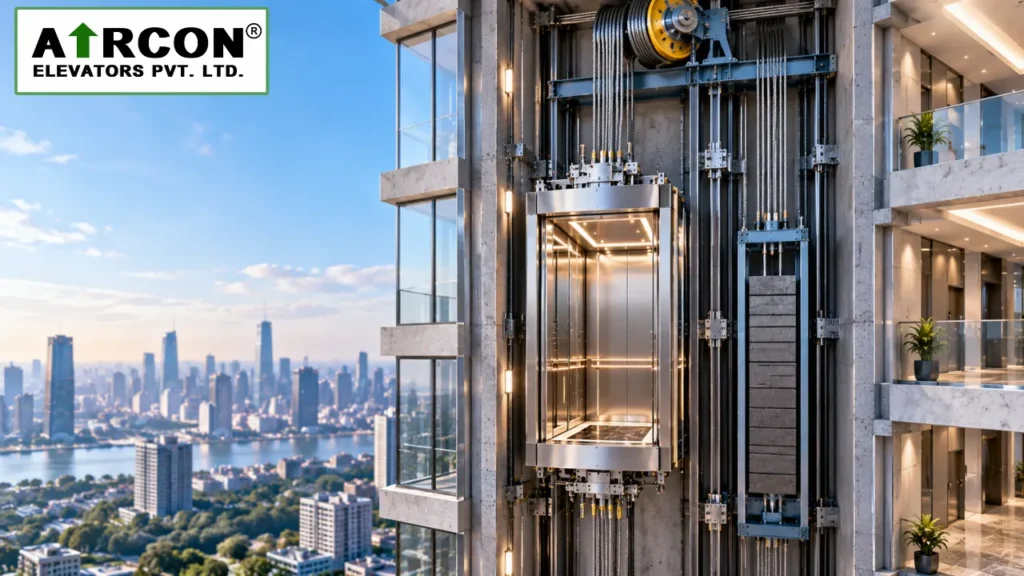
Have you ever wondered how an Elevator Counterweight helps an elevator lift hundreds of kilograms smoothly without putting excessive strain on the motor? Many people assume that the elevator motor lifts the entire cabin weight by itself. However, that’s only part of the story.
Instead, the real hero behind smooth and energy-efficient elevator operation is the Elevator Counterweight. Because it balances most of the cabin’s weight, the elevator requires much less power during every trip. This heavy balancing system works alongside the elevator cabin to reduce the amount of power required for every trip.
Whether you’re installing a residential lift, managing a commercial building, or simply curious about elevator engineering, understanding how an Elevator Counterweight works can help you appreciate one of the most important components inside any traction elevator. As a result, you’ll better understand why traction elevators operate so efficiently.
An Elevator Counterweight is a heavy mass connected to the elevator cabin using steel wire ropes that pass over a drive sheave. As the cabin moves up, the counterweight moves down, and vice versa. By balancing a large portion of the cabin’s weight, the counterweight reduces motor workload, improves energy efficiency, minimizes wear on mechanical components, and ensures smooth, safe operation.
What Is an Elevator Counterweight?
Simply put, an Elevator Counterweight is a balancing weight installed inside the elevator shaft opposite the elevator cabin.
Instead, of allowing the motor to lift the full cabin weight every time the elevator travels, the counterweight shares the load. As a result, the elevator machine requires significantly less power. As a result, this balancing system significantly reduces the effort required from the elevator machine.
Typically, the counterweight consists of stacked cast iron or steel blocks secured inside a rigid metal frame. It travels on its own guide rails and moves in the opposite direction of the elevator cabin.
For example:
- When the elevator cabin goes up, the counterweight moves down.
- When the elevator cabin goes down, the counterweight moves up.
Because both components move together, the system remains balanced and requires much less energy than lifting the cabin alone.
This principle has been used in traction elevators for decades because it provides excellent efficiency, reliability, and long-term performance.
Why Is an Elevator Counterweight Important?
Without an elevator counterweight, the drive motor would need to lift the entire weight of the cabin and its passengers during every trip.
This would lead to:
- Higher electricity consumption
- Increased motor load
- Faster wear on steel ropes
- Greater stress on bearings and brakes
- Reduced ride comfort
- Shorter equipment lifespan
Fortunately, adding a properly sized counterweight solves many of these challenges. Moreover, it improves overall elevator efficiency and passenger comfort.
As a result, the main benefits include:
- Reduces motor workload
- Improves energy efficiency
- Provides smoother acceleration and deceleration
- Reduces vibration and noise
- Extends the life of the elevator system
- Lowers maintenance costs
- Improves passenger comfort
- Helps maintain balanced operation
Because of these advantages, virtually every modern traction elevator uses a counterweight system.
How Does an Elevator Counterweight Work?
Fortunately, the working principle is surprisingly simple. First, the elevator controller receives a travel request.
Instead of lifting the full cabin weight directly, the elevator motor only moves the difference between the cabin load and the counterweight.
Here’s how the process works:
- A passenger enters the elevator cabin.
- The elevator controller receives the travel request.
- The drive motor rotates the traction sheave.
- Steel wire ropes move over the sheave.
- The elevator cabin travels in one direction.
- At the same time, the counterweight travels in the opposite direction.
- The motor only supplies the additional force needed to overcome the weight difference and friction.
Because the counterweight already balances most of the cabin weight, the motor consumes much less electricity.
This is one of the biggest reasons why traction elevators are considered highly energy-efficient.
What Is an Elevator Counterweight Made Of?
The exact materials may vary depending on the elevator manufacturer, but most counterweights contain heavy, durable materials designed to provide long-lasting performance.
For example, common materials include:
Cast Iron Weights
Cast iron remains one of the most widely used materials because it offers high density, excellent durability, and long service life.
Steel Weight Blocks
Many modern elevators use precision-engineered steel blocks that provide accurate balancing while reducing overall frame size.
Concrete-Filled Weights
Some heavy-duty industrial elevators use reinforced concrete blocks inside steel frames where additional mass is required.
Counterweight Frame
The weight blocks are securely held inside a robust steel frame designed to prevent movement during operation.
The complete assembly travels vertically along dedicated guide rails inside the elevator shaft.
Main Components of an Elevator Counterweight System
In addition, several components work together to ensure smooth and reliable operation.
1.Counterweight Frame
The frame holds all weight blocks securely and maintains structural stability during travel.
2.Weight Blocks
These individual blocks provide the required balancing mass and can be added or removed during installation to achieve proper balance.
3.Guide Shoes
Guide shoes help the counterweight move smoothly along the guide rails while minimizing vibration and friction.
4.Guide Rails
Separate guide rails keep the counterweight aligned throughout its entire travel path.
Steel Wire Ropes
The counterweight and cabin remain connected through multiple high-strength steel wire ropes.
Drive Sheave
The traction sheave transfers motor rotation into vertical movement of both the cabin and the counterweight.
Together, these components create a balanced system capable of safely transporting passengers for millions of operating cycles.
How Is the Counterweight Connected to the Elevator?
Basically, the connection between the cabin and the counterweight is both simple and highly reliable.
Several high-strength steel wire ropes pass over the drive sheave located above the elevator shaft.
One end of the ropes is attached to the elevator cabin, while the opposite end is attached to the counterweight frame.
When the drive motor rotates the traction sheave:
- The ropes move.
- The cabin travels in one direction.
- The counterweight travels in the opposite direction.
Because both sides remain permanently connected, the system maintains balance throughout the elevator’s operation.
How Is an Elevator Counterweight Calculated?
One of the most common questions people ask is whether the counterweight weighs exactly the same as the elevator cabin.
The answer is No.
Instead, elevator engineers calculate the counterweight using a standard engineering formula that balances the empty cabin plus a percentage of its rated passenger load.
The commonly used formula is:
Counterweight = Empty Cabin Weight + 40–50% of Rated Load
This calculation allows the elevator to operate efficiently whether it is empty, partially occupied, or carrying passengers close to its rated capacity.
For example:
| Elevator Specification | Weight |
| Empty Cabin Weight | 700 kg |
| Rated Passenger Capacity | 600 kg |
| 50% Passenger Load | 300 kg |
| Counterweight Weight | 1,000 kg |
Because the counterweight balances only part of the passenger load, the motor never has to lift the entire cabin weight by itself.
Why Isn’t the Counterweight Equal to the Full Cabin Weight?
Many people believe that the counterweight should weigh exactly the same as a fully loaded elevator.
However, doing so would actually reduce efficiency.
If the counterweight matched the maximum loaded cabin weight:
- An empty cabin would become too light.
- The motor would work harder when the cabin travels downward.
- Energy consumption would increase.
- Ride quality could become less stable.
By balancing the empty cabin plus approximately half of the rated passenger load, the elevator remains efficient throughout most daily operating conditions.
This balance point offers the best combination of:
- Energy efficiency
- Smooth operation
- Reduced motor stress
- Lower maintenance costs
- Longer equipment life
Elevator Counterweight in Traction vs Hydraulic Elevators
Not every elevator uses a counterweight.
The presence of an Elevator Counterweight depends on the drive system.
Elevator Counterweight in Traction Elevators
Traction elevators always use a counterweight because they rely on steel wire ropes and a traction machine to move the cabin.
The counterweight helps:
- Balance the cabin
- Reduce motor load
- Improve energy efficiency
- Minimize rope wear
- Deliver smoother travel
This is why traction elevators are commonly installed in residential towers, office buildings, hotels, hospitals, and shopping malls.
Elevator Counterweight in Hydraulic Elevators
On the other hand, hydraulic elevators operate differently.
Instead of using steel ropes and a balancing weight, they raise the cabin using hydraulic oil pressure inside a cylinder.
Because the lifting force comes directly from the hydraulic system, most hydraulic elevators do not require an elevator counterweight.
However, the hydraulic pump must work harder during upward travel, which generally makes hydraulic elevators less energy-efficient than traction elevators.
What Happens If the Elevator Counterweight Is Incorrect?
To ensure safe and efficient elevator operation, proper counterweight balancing is essential.
If the counterweight is too heavy or too light, several operational problems can occur.
Common issues include:
- Increased electricity consumption
- Excessive motor workload
- Faster rope wear
- Uneven braking
- Rough starts and stops
- Cabin vibration
- Poor floor leveling
- Higher maintenance costs
For this reason, professional calibration is performed during installation and after any major modernization work.
Safety Features That Protect the Elevator Counterweight
Although passengers never see it, the counterweight includes several important safety components. Moreover, these features ensure stable movement even after years of continuous operation.
These features ensure stable movement even after years of continuous operation.
Guide Rails
The counterweight moves along dedicated guide rails that prevent sideways movement and maintain proper alignment.
Guide Shoes
Guide shoes reduce friction while allowing the counterweight to travel smoothly inside the shaft.
They also help minimize vibration and noise.
Steel Wire Ropes
Multiple high-strength steel ropes connect the cabin and counterweight.
Instead of relying on a single rope, elevators use several ropes to provide additional safety and load distribution.
Overspeed Governor
If the elevator travels faster than its designed speed, the overspeed governor activates the safety gear to stop uncontrolled movement.
This independent safety device protects both the cabin and the counterweight system.
Safety Gear
Modern traction elevators include mechanical safety gear that can securely grip the guide rails during emergency situations.
These systems operate independently of the drive motor and provide an additional layer of passenger protection.
Modern elevators may also include an Automatic Rescue Device (ARD) to safely move passengers to the nearest floor during a power failure.
Common Elevator Counterweight Problems
Although counterweight systems are extremely reliable, they can develop issues over time without proper maintenance.
Some of the most common problems include:
Worn Guide Shoes
Continuous movement gradually wears the guide shoes, increasing vibration and noise.
Loose Counterweight Blocks
If retaining hardware becomes loose, the weight blocks may shift inside the frame, causing unusual sounds and imbalance.
Rope Wear
Steel wire ropes naturally wear after years of operation.
Regular inspections help identify damaged ropes before they become a safety concern.
Guide Rail Misalignment
Improper guide rail alignment can create additional friction and reduce ride quality.
Poor Counterweight Calibration
After replacing major components, technicians must verify that the counterweight remains properly balanced.
Incorrect calibration can reduce efficiency and increase mechanical stress.
Signs Your Elevator Counterweight May Need Inspection
Several warning signs may indicate that the counterweight system requires professional attention.
These include:
- Excessive vibration during travel
- Unusual grinding or knocking sounds
- Rough acceleration or stopping
- Poor floor leveling
- Increased motor noise
- Higher electricity consumption
- Frequent maintenance issues
- Rope wear appearing earlier than expected
Ignoring these warning signs may lead to larger mechanical problems over time.
Therefore, routine inspections play an important role in maintaining reliable elevator performance.
How to Maintain an Elevator Counterweight
Although an Elevator Counterweight requires very little day-to-day attention, regular maintenance is essential to ensure smooth elevator operation and long equipment life.
A preventive maintenance program helps technicians identify wear before it becomes a major issue.
Here are some important maintenance practices:
Inspect Steel Wire Ropes Regularly
The counterweight depends on high-strength steel wire ropes to move safely inside the elevator shaft.
Technicians should inspect the ropes for:
- Broken wires
- Corrosion
- Uneven wear
- Improper tension
- Lubrication condition
Replacing worn ropes at the right time helps maintain safe and efficient operation.
Check Guide Rails and Guide Shoes
The counterweight travels along dedicated guide rails throughout its entire movement.
During routine inspections, technicians should verify:
- Rail alignment
- Guide shoe wear
- Loose mounting brackets
- Excessive vibration
- Proper lubrication where applicable
Well-maintained guide rails improve ride comfort and reduce mechanical stress.
Verify Counterweight Balance
Whenever major elevator components are replaced, technicians should confirm that the Elevator Counterweight remains correctly balanced.
An improperly balanced system may increase:
- Motor workload
- Electricity consumption
- Rope wear
- Brake wear
- Vibration
Correct balancing improves both safety and long-term performance.
Inspect Counterweight Frame
The counterweight frame should also be inspected for:
- Loose fasteners
- Structural damage
- Corrosion
- Shifted weight blocks
Keeping the frame secure prevents unnecessary vibration during elevator travel.
Follow the Manufacturer’s Maintenance Schedule
Every elevator manufacturer recommends periodic inspections based on usage and operating conditions.
Following the prescribed maintenance schedule helps ensure that the counterweight system continues operating safely and efficiently for many years.
Common Myths About Elevator Counterweights
However, many people misunderstand how an Elevator Counterweight actually works. Therefore, let’s separate myths from facts.
Let’s separate myths from facts.
Myth 1: The Counterweight Is Heavier Than the Elevator
False.
The counterweight is carefully calculated to balance the empty cabin plus approximately 40–50% of the rated passenger load, not the fully loaded elevator.
Myth 2: Hydraulic Elevators Use Counterweights
False.
Most hydraulic elevators lift the cabin using hydraulic pressure rather than a counterweight system.
Myth 3: The Counterweight Can Fall Freely
False.
Modern elevators include guide rails, guide shoes, multiple steel wire ropes, safety devices, and braking systems that help keep the counterweight moving safely within the shaft.
Myth 4: Counterweights Never Need Maintenance
False.
Although counterweights are highly durable, components such as guide shoes, ropes, guide rails, and retaining hardware require periodic inspection to ensure reliable operation.
Frequently Asked Questions (FAQs)
An Elevator Counterweight is a balancing weight connected to the elevator cabin through steel wire ropes. It reduces the amount of work the motor must perform, improving efficiency and ensuring smooth operation.
The counterweight balances much of the cabin’s weight, reducing motor load, lowering electricity consumption, minimizing wear on components, and extending the elevator’s service life.
No. Most traction elevators use an Elevator Counterweight, while most hydraulic elevators operate without one because they use hydraulic cylinders to lift the cabin.
Its weight depends on the elevator’s design. Typically, it equals the empty cabin weight plus around 40–50% of the rated passenger capacity.
Counterweight failures are rare when elevators receive regular maintenance. Routine inspections help identify issues such as rope wear, guide shoe wear, or loose counterweight blocks before they become serious.
Yes. Because the motor only moves the difference between the cabin load and the counterweight, less electrical energy is required during normal operation.
Final Thoughts
The Elevator Counterweight is one of the most important components in any traction elevator. By balancing the elevator cabin, it allows the drive motor to work more efficiently, reduces energy consumption, minimizes wear on mechanical parts, and provides a smoother ride for passengers.
Although passengers rarely see the counterweight, it plays a critical role in every elevator journey. Combined with steel wire ropes, guide rails, safety gear, and intelligent control systems, it helps ensure safe and reliable vertical transportation every day. Following proper elevator safety practices and regular inspections helps maximize elevator life. Learn more about Passenger elevators and how different elevator systems work.
Whether you’re planning to install a new elevator, managing an existing building, or simply interested in elevator engineering, understanding how an Elevator Counterweight works gives you valuable insight into the technology that keeps modern elevators efficient, dependable, and safe.