
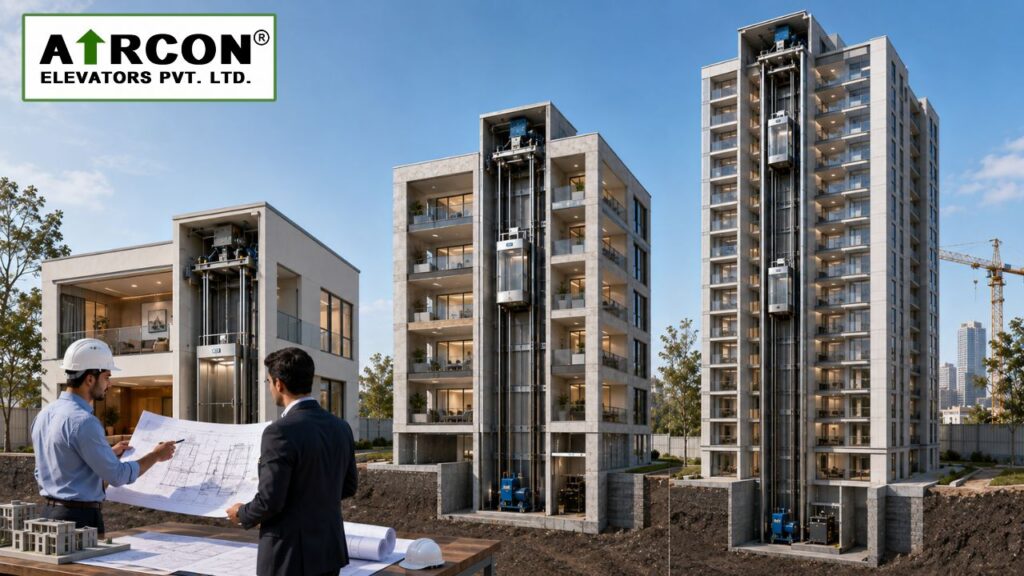
When planning a new building, many property owners focus on elevator type or cabin design. However, the number of floors plays an equally important role. It affects not only the overall elevator cost but also the lift’s capacity, speed, motor selection, safety systems, and installation requirements.
Whether you’re building a two-storey home or a multi-storey commercial complex, understanding how floor count influences elevator specifications will help you choose the right solution and avoid unnecessary expenses.
At Aircon Elevators Pvt. Ltd., we evaluate every project individually to recommend an elevator that delivers the right balance of performance, safety, and long-term value.
Why Floor Count Matters
Every additional floor increases the elevator’s travel distance. As the travel height grows, the elevator requires longer guide rails, more landing doors, additional wiring, and a more advanced control system. These changes naturally increase both equipment and installation costs.
Therefore, selecting an elevator based only on cabin design or passenger capacity rarely produces the best results.
Ground +1 or Two-Floor Buildings
Most villas, duplex homes, and small offices fall into this category.
For these buildings, homeowners often choose:
- Home Elevators
- Hydraulic Elevators
- Compact MRL Elevators
- Pitless Home Lifts
Since the travel height remains relatively short, installation becomes simpler and the overall project cost stays lower.
Three to Five Floors
As building height increases, elevator specifications also change.
Manufacturers may recommend:
- Passenger Elevators
- Machine Room Less (MRL) Elevators
- Traction Elevators
- Higher-capacity drive systems
These elevators handle more passengers efficiently while maintaining smooth and reliable performance.
Six Floors and Above
Medium and high-rise buildings demand stronger engineering.
At this height, elevators often require:
- More powerful traction machines
- Advanced controllers
- Additional landing doors
- Longer guide rails
- Enhanced braking systems
- Higher-speed operation
For taller buildings, traction elevators generally provide better efficiency and long-term performance than hydraulic systems.
How Floor Count Increases Elevator Cost
Several components grow as the building becomes taller.
Longer Guide Rails
- Higher buildings require longer guide rails to support smooth cabin movement.
Additional Landing Doors
- Every extra floor needs another landing door, door frame, call button, and indicator panel.
More Wiring
- Additional floors require longer electrical cables, travelling cables, communication lines, and control wiring.
Larger Counterweight System
- Traction elevators often need larger counterweight arrangements for greater travel heights.
Stronger Drive System
- As travel distance increases, manufacturers may recommend more powerful motors and controllers to maintain smooth operation.
Together, these factors increase the overall project cost.
Does Floor Count Affect Elevator Capacity?
Yes, but not directly.
Floor count alone does not determine passenger capacity. Instead, taller buildings usually experience higher passenger traffic.
For example:
- A two-floor villa may only require a 4-person home lift.
- A five-floor apartment may benefit from a 6- or 8-passenger elevator.
- A commercial building with heavy daily traffic may require a 10- or 13-passenger passenger elevator.
Choosing the right capacity improves passenger flow and reduces waiting time.
Floor Count Also Influences Elevator Speed
Speed becomes increasingly important as buildings become taller.
Typical recommendations include:
| Building Height | Recommended Speed |
| G+1 to G+2 | Standard Speed |
| G+3 to G+5 | Medium Speed |
| 6 Floors and Above | Higher-Speed Elevator |
Selecting the appropriate speed improves passenger comfort while reducing travel time.
Planning Ahead Can Reduce Future Costs
Many building owners design an elevator only for their current needs.
However, if future expansion is possible, discussing it during the planning stage can save significant modification costs later.
Early planning helps optimize:
- Shaft dimensions
- Machine selection
- Electrical infrastructure
- Landing positions
- Future maintenance access
A well-planned installation often proves more economical than upgrading an undersized system later.
Other Factors That Affect Elevator Cost
Although floor count plays a major role, several other factors also influence pricing.
These include:
- Elevator Type
- Passenger Capacity
- Travel Speed
- Cabin Finish
- Door Configuration
- Safety Features
- Glass or Steel Cabin
- Civil Construction
- Customization
- Installation Complexity
A complete project evaluation ensures accurate pricing and the right technical specifications.
Why Choose Aircon Elevators?
At Aircon Elevators Pvt. Ltd., we manufacture customized elevator solutions for residential, commercial, healthcare, and industrial projects across India.
We provide:
- Passenger Elevators
- Home Lifts
- Goods Elevators
- Capsule Elevators
- Hospital Elevators
- Hydraulic Elevators
- MRL Elevators
- Professional Installation
- Annual Maintenance Contracts (AMC)
- Elevator Modernization
Our team studies your building’s floor count, passenger traffic, and available space before recommending the most suitable elevator solution.
Frequently Asked Questions
Yes. Additional floors require more guide rails, landing doors, wiring, safety equipment, and installation work, which increases the overall project cost.
Many homeowners choose a home lift, hydraulic elevator, or compact MRL elevator for two-floor residential buildings.
Yes. Higher-speed elevators reduce travel time and improve passenger convenience in medium and high-rise buildings.
Generally, taller buildings experience higher elevator usage, which can increase maintenance requirements over time.
Yes. Our experts evaluate your building’s height, traffic, capacity needs, and layout before recommending a customized elevator solution.
Floor count influences much more than the final price of an elevator. It affects travel height, lift technology, passenger capacity, speed, safety systems, and installation requirements. Choosing an elevator that matches your building’s height ensures reliable performance, efficient operation, and better long-term value.
At Aircon Elevators Pvt. Ltd., we help homeowners, builders, architects, and developers select elevator systems that match their project’s technical requirements while maintaining the highest standards of safety and quality.