
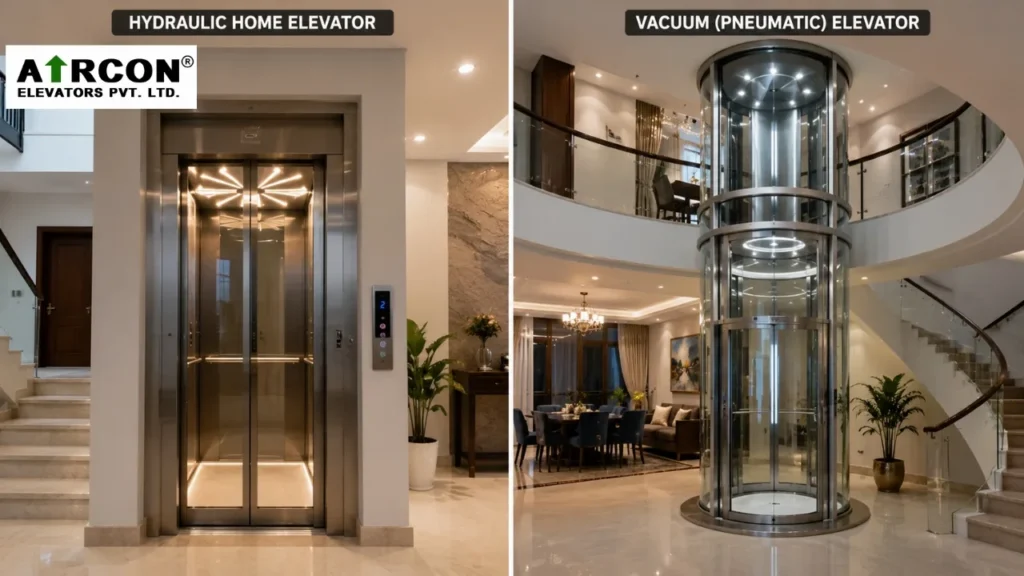
Choosing a home elevator is no longer only about adding convenience. Today, homeowners also consider space, installation requirements, running costs, appearance, capacity, and long-term maintenance before selecting a lift.
Two options that often attract attention are hydraulic home lifts and vacuum or pneumatic elevators. Both technologies can work well in residential properties, but they operate differently and suit different types of homes.
So, how much does a hydraulic home lift cost compared with a vacuum elevator? And which one offers better value?
The answer depends on your building layout, number of floors, passenger requirements, available space, and the type of installation you need.
Hydraulic Home Lift vs. Vacuum Elevator at a Glance
| Feature | Hydraulic Home Lift | Vacuum/Pneumatic Elevator |
| Working Principle | Hydraulic pressure moves the cabin | Air-pressure difference moves the cabin |
| Best For | Low-rise homes | Compact homes and retrofit projects |
| Pit Requirement | Usually shallow or project-dependent | Generally no conventional pit |
| Shaft Requirement | Depends on design | Self-supporting cylindrical structure |
| Capacity | Available in various capacities | Usually lower residential capacity |
| Appearance | Customizable cabin designs | Panoramic cylindrical design |
| Installation | Requires more planning | Can simplify installation |
| Typical 2026 Price* | About ₹8–20 lakh | About ₹10–22 lakh |
| Ideal Advantage | Strong, smooth operation | Minimal civil work and panoramic design |
*Indicative market ranges only. Actual quotations vary according to specifications, location, installation, customization, taxes and civil work. Current 2026 Indian references place hydraulic systems broadly around ₹8–20 lakh and pneumatic systems around ₹10–22 lakh.
How Does a Hydraulic Home Lift Work?
A hydraulic elevator uses a pump, hydraulic fluid and cylinder to move the cabin.
When you select a floor, the pump pushes hydraulic fluid into the cylinder. This pressure moves the piston upward and carries the elevator cabin with it. During downward travel, the system controls the release of fluid to bring the cabin down smoothly.
This technology has been used for residential and commercial lifting applications for many years.
Hydraulic systems can provide a smooth ride and strong lifting capability, making them suitable for many low-rise residential projects.
How Does a Vacuum Home Elevator Work?
A vacuum or pneumatic elevator uses air-pressure differences rather than conventional ropes or hydraulic pistons.
The cabin travels inside a sealed cylindrical enclosure. A turbine reduces the air pressure above the cabin, while atmospheric pressure below it helps push the cabin upward. Controlled air release then allows the cabin to descend.
One of the biggest attractions of this design is its installation flexibility. Pneumatic elevators generally don’t require a conventional deep pit, traditional shaft construction, or separate machine room, which can make them attractive for existing homes and retrofit projects.
Hydraulic Home Lift Cost in India
The price of a hydraulic home lift depends heavily on its specifications.
For 2026, indicative Indian market references place hydraulic home elevators in a broad range of approximately ₹8 lakh to ₹20 lakh. Some suppliers quote lower starting prices for basic configurations, while premium cabins, higher capacities and additional floors can push the investment higher.
The final quotation can change because of:
- Number of floors
- Passenger capacity
- Cabin dimensions
- Automatic or manual doors
- Cabin finishes
- Hydraulic equipment
- Safety systems
- Electrical requirements
- Civil work
- Installation location
- Customization
Therefore, homeowners should treat online prices as a starting point rather than a final project cost.
Vacuum Elevator Cost in India
Vacuum elevators generally occupy a higher price segment than basic residential lifting systems because of their specialized pneumatic technology and panoramic cylindrical construction.
Current 2026 market references indicate an approximate range of ₹10 lakh to ₹22 lakh for pneumatic/vacuum home elevators, although the actual price can vary significantly by model, capacity, travel height, customization and installation requirements.
Some market listings show starting prices around ₹12 lakh, while premium models can cost substantially more.
Which One Requires Less Construction Work?
This is one of the biggest differences between the two technologies.
A hydraulic home elevator may require appropriate space for its lifting equipment and project-specific civil provisions. The exact requirements depend on the elevator design and building structure.
A pneumatic elevator, on the other hand, can be particularly attractive for retrofit installations because its self-supporting tube design can reduce the need for conventional shaft construction and pit excavation.
For an existing house where major structural changes are difficult, this difference can become important.
Which Elevator Looks Better?
This depends on your personal preference.
Hydraulic home lifts offer considerable flexibility in cabin design. Homeowners can select finishes such as:
- Stainless steel
- Glass
- Mirror panels
- Designer flooring
- LED ceilings
- Custom control panels
Vacuum elevators have a distinctive panoramic cylindrical appearance. Their transparent enclosure can become an architectural feature inside a modern villa or duplex.
If aesthetics are your priority, a vacuum elevator can create a dramatic visual effect.
Hydraulic vs. Vacuum: Running and Maintenance Considerations
Both technologies require professional preventive maintenance.
With hydraulic systems, maintenance teams need to monitor components such as the pump, valves, hydraulic fluid, cylinder and electrical controls.
Vacuum systems have a different maintenance profile because they rely on turbines, seals, sensors, valves and pneumatic controls.
The right maintenance schedule depends on the equipment and manufacturer’s recommendations. Therefore, homeowners should compare not just the initial quotation but also the AMC terms, spare-parts availability and service support before making a decision.
Which Is Better for a 2- or 3-Storey Home?
There isn’t one universal winner.
Choose a Hydraulic Home Lift When:
- You want a conventional residential elevator solution.
- You need a stronger capacity option.
- Your building can accommodate the required infrastructure.
- You prefer greater cabin customization.
- You want a smooth lifting system for regular family use.
Consider a Vacuum Elevator When:
- Your home has limited construction space.
- You want to minimize major civil modifications.
- You are retrofitting an elevator into an existing property.
- You prefer panoramic glass aesthetics.
- You have relatively modest passenger requirements.
Pneumatic systems are commonly positioned for shorter residential travel and smaller passenger groups, while hydraulic systems can provide broader capacity options.
Don’t Compare Only the Elevator Price
This is where many homeowners make a mistake.
Suppose one company quotes ₹10 lakh and another quotes ₹13 lakh. The cheaper quotation isn’t automatically better.
Ask both companies whether their quotation includes:
- Elevator equipment
- Cabin
- Doors
- Controller
- Safety systems
- Installation
- Electrical work
- Civil work
- Transportation
- Testing and commissioning
- GST
- AMC
- Warranty
Some published market estimates specifically exclude civil work and installation, while others bundle certain services into their advertised prices.
A detailed quotation makes comparison much easier.
Why Choose Aircon Elevators?
At Aircon Elevators Pvt. Ltd., we understand that every home has different requirements. The right elevator depends on available space, floor height, passenger needs, building structure, design preferences, and budget.
Our team can help homeowners evaluate their project requirements and select a suitable elevator solution rather than simply recommending a system based on price.
We provide elevator solutions for residential and commercial applications, along with installation, maintenance, and modernization services.
Frequently Asked Questions
Generally, basic hydraulic systems can fall below premium pneumatic models, but actual pricing depends on specifications, customization and installation requirements.
Vacuum elevators generally require fewer conventional structural provisions because their self-supporting cylindrical design can eliminate the need for a traditional pit and shaft in many installations.
They can be a useful option for retrofit projects where homeowners want to minimize major structural modifications. A site assessment remains essential before installation.
For homes with higher passenger demand or greater capacity requirements, a hydraulic or traction-based solution may provide more flexibility. The best choice depends on the building and usage pattern.
Home elevator prices vary widely. Current market references place hydraulic systems roughly around ₹8–20 lakh and pneumatic/vacuum systems around ₹10–22 lakh, before or depending on items such as GST, civil work and installation.
The choice between a hydraulic home lift and a vacuum elevator should not depend on price alone. Hydraulic technology can offer strong, smooth and customizable residential performance, while pneumatic elevators stand out for their compact installation approach and distinctive panoramic design.
If you’re building a new home, a hydraulic solution may offer the combination of capacity and customization you need. For an existing property where construction work is a major concern, a vacuum elevator can be worth considering.
Before making the final decision, compare the complete project cost, installation requirements, maintenance support, warranty, safety features and long-term service availability.
At Aircon Elevators Pvt. Ltd., our team can assess your project requirements and help you identify an elevator solution that fits your building, usage and budget.