
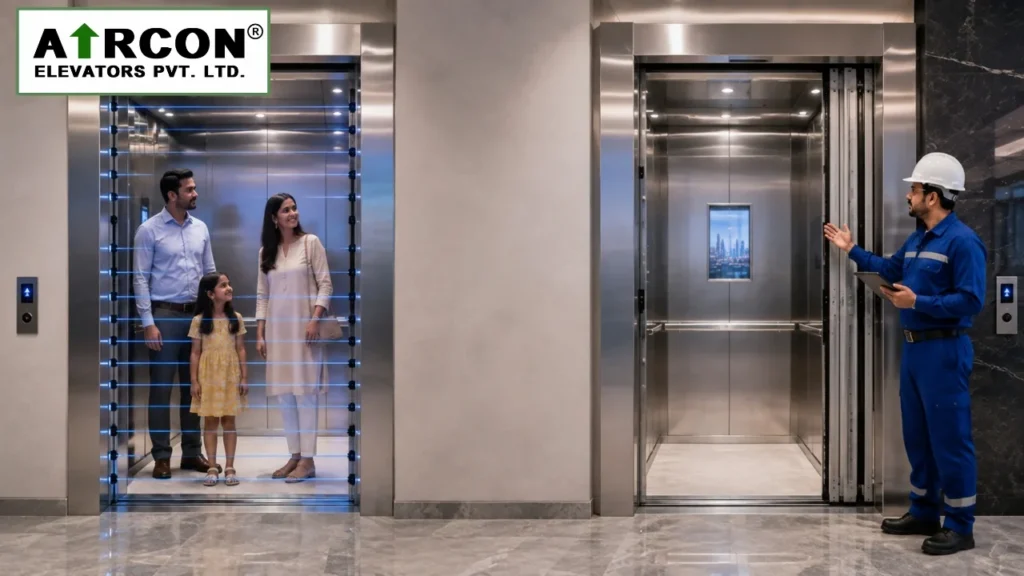
Elevator doors open and close lots of times every month. Elevator manufacturers install door protection sensors to keep passengers safe and prevent the doors from closing on people or objects. Two of the most common technologies are infrared light curtains and mechanical safety edges.
While both systems improve passenger safety, they work differently and offer different levels of protection. Understanding these technologies helps building owners choose the right solution for new installations and elevator modernization projects.
What Is an Infrared Light Curtain?
Manufacturers install an infrared light curtain along both sides of the elevator door to provide non-contact passenger protection. It creates multiple invisible infrared beams across the entire doorway.
When a person, wheelchair, luggage, or any object interrupts one or more beams, the elevator controller immediately stops the closing door and reopens it before contact occurs. Modern light curtains provide continuous protection over most of the door opening, making them the preferred choice for new passenger elevators.
What Is a Mechanical Safety Edge?
A mechanical safety edge uses a pressure-sensitive strip on the leading edge of the elevator door to detect contact with people or objects.
Unlike an infrared curtain, it detects an obstruction only after the door physically touches a person or object. The impact compresses the safety edge, which sends a signal to reopen the doors.
Although many older elevators still use this technology, modern elevators increasingly replace it with non-contact sensing systems because they provide earlier detection and improved passenger protection.
Infrared Curtains vs. Mechanical Edges
| Feature | Infrared Curtain | Mechanical Safety Edge |
| Detection Method | Non-contact infrared beams | Physical contact |
| Passenger Protection | Detects before contact | Detects after contact |
| Coverage | Nearly the full doorway | Door edge only |
| Response | Fast automatic reopening | Reopens after impact |
| Maintenance | Fewer moving parts | Mechanical parts require regular inspection |
| Best Use | Modern passenger and commercial elevators | Older elevator systems and some retrofits |
For most new installations, infrared light curtains provide broader coverage and a better passenger experience.
Why Infrared Curtains Are Popular Today
Many building owners now choose infrared curtains because they offer several advantages:
- Contact-free obstacle detection
- Improved passenger safety
- Better protection for children, wheelchairs, and luggage
- Smooth door operation
- Reduced door-related complaints
- Suitable for modernization projects
Since the doors reopen before touching an obstruction, passengers enjoy a safer and more comfortable ride.
When Are Mechanical Safety Edges Still Used?
Mechanical safety edges still appear in many older elevators because they are simple and cost-effective.
They may remain suitable when:
- Modernization has not yet been completed.
- Older elevator systems continue operating safely.
- A backup protection system is required.
Some elevator specifications even combine infrared light curtains with a mechanical safety edge to provide an additional layer of protection if one system experiences a fault.
Why Preventive Maintenance Matters
No matter which technology your elevator uses, regular maintenance is essential.
A professional inspection should include:
- Sensor alignment
- Door reopening performance
- Wiring and electrical connections
- Door operator inspection
- Mechanical edge condition (if installed)
- Door opening and closing speed
Routine maintenance helps ensure the door protection system responds correctly and reduces the risk of unexpected failures.
How Aircon Elevators Can Help
At Aircon Elevators Pvt. Ltd., we provide professional elevator installation, modernization, maintenance, and repair services for residential, commercial, industrial, and institutional buildings.
Whether you want to upgrade an older mechanical safety edge to a modern infrared curtain or maintain your existing elevator system, our experienced engineers deliver reliable solutions focused on safety, performance, and long-term reliability.
Frequently Asked Questions
Infrared light curtains generally provide better passenger protection because they detect people and objects before the elevator doors make contact.
Yes. Building owners can upgrade many older elevators with infrared light curtains during modernization, provided the elevator design and controller support the upgrade.
Yes. They are still found on many older elevators and can also serve as a backup protection system in some installations.
Door sensors should be checked during every scheduled preventive maintenance visit to ensure reliable operation and passenger safety.
Elevator door sensors play a vital role in passenger safety. While mechanical safety edges continue to serve many existing elevators, infrared light curtains have become the preferred technology because they provide faster, non-contact detection and wider doorway coverage.
Regular inspections, preventive maintenance, and timely upgrades help keep your elevator operating safely and efficiently for years to come.