
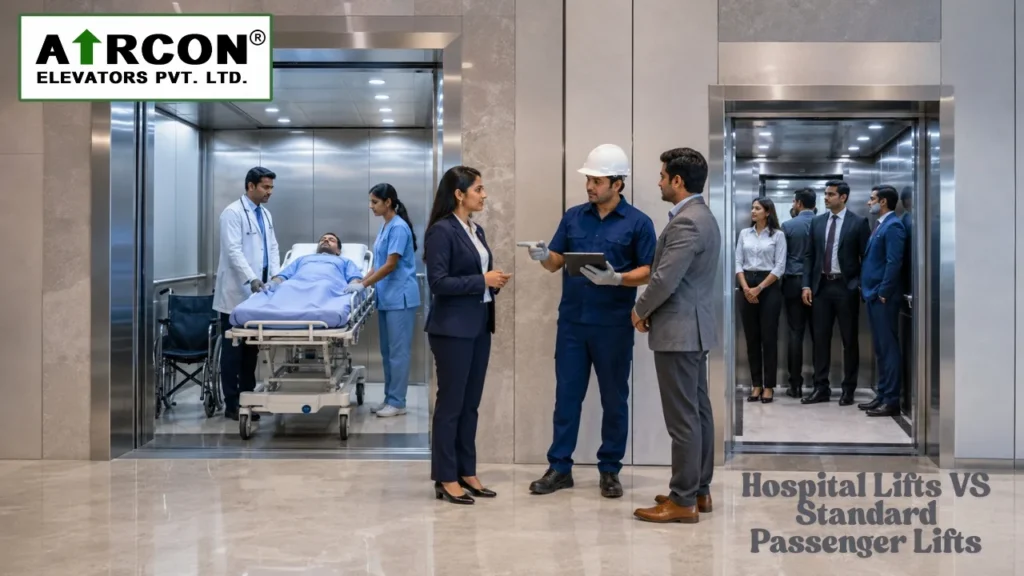
Selecting the right elevator is critical for healthcare facilities. While hospital lifts and standard passenger lifts may appear similar, they serve very different purposes. A hospital lift must transport patients, stretchers, medical staff, and life-saving equipment safely while meeting strict hygiene and accessibility requirements. Standard passenger lifts, on the other hand, focus on moving people efficiently in residential and commercial buildings.
If you’re planning a hospital, nursing home, diagnostic center, or healthcare facility, understanding these differences will help you choose the right elevator system.
What Is a Hospital Lift?
A hospital lift, also known as a bed or stretcher elevator, is specifically engineered for healthcare environments. It accommodates hospital beds, wheelchairs, stretchers, attendants, and medical equipment while providing a smooth and stable ride for patient comfort.
What Is a Standard Passenger Lift?
A standard passenger lift is designed for offices, apartments, hotels, shopping malls, and commercial buildings. Its primary purpose is to transport people quickly and comfortably during everyday use. Although modern passenger lifts include important safety features, they are not designed for medical transport or infection-control requirements.
Engineering Differences Between Hospital and Passenger Lifts
1. Cabin Size and Load Capacity
- Hospital lifts feature larger cabins and higher load capacities so they can safely carry hospital beds, stretchers, medical staff, and equipment together. Passenger lifts usually have smaller cabins optimized for daily foot traffic rather than oversized medical loads.
2. Wider Door Openings
- Hospital elevators use wider automatic doors to allow stretchers and wheelchairs to enter and exit without difficulty. Passenger lifts generally use narrower door openings because they mainly serve individual passengers.
3. Ride Comfort
- A sudden jerk during elevator travel can affect patient safety. Hospital lifts use advanced motion control for smooth acceleration, deceleration, and accurate floor leveling to reduce vibration during patient transport.
4. Emergency Readiness
- Many hospital elevators include emergency power operation, priority controls, and features that support uninterrupted patient movement during critical situations. Standard passenger elevators generally focus on normal building transportation rather than medical emergencies.
Hygienic Differences
Healthcare facilities require much higher hygiene standards than residential or commercial buildings.
Hospital lifts commonly include:
- Stainless-steel interiors
- Easy-to-clean wall panels
- Chemical-resistant finishes
- Durable flooring designed for frequent sanitization
- Cabin layouts that simplify routine cleaning
These features help reduce contamination risks and support strict hospital cleaning protocols. Passenger lifts may prioritize decorative finishes over medical-grade hygiene.
Accessibility Features
Hospital elevators support patients, visitors, and healthcare professionals with accessibility features such as:
- Braille control buttons
- Voice announcements
- Wheelchair-friendly controls
- Wide entrances
- Non-slip flooring
- Handrails for additional support
These features improve accessibility and make patient transport safer and more efficient.
Which Buildings Need Hospital Lifts?
Hospital lifts are ideal for:
- Multi-specialty hospitals
- Nursing homes
- Diagnostic centers
- Rehabilitation centers
- Medical colleges
- Healthcare institutions
For residential apartments, offices, hotels, and commercial buildings, a standard passenger lift is usually the appropriate choice.
Installing a passenger lift in place of a hospital lift can create operational challenges, including limited space for stretchers, slower emergency response, and reduced patient comfort. Selecting an elevator designed for healthcare environments improves workflow, supports infection-control practices, and enhances overall patient care. Healthcare planning guidelines also recommend separating patient, service, and public traffic wherever practical to improve efficiency and hygiene.
Why Choose Aircon Elevators Pvt. Ltd.?
Aircon Elevators Pvt. Ltd. designs and installs customized elevator solutions for hospitals, commercial buildings, residential projects, and industrial facilities. Our team works closely with architects and healthcare planners to recommend elevator systems that meet project requirements for safety, accessibility, reliability, and long-term performance.
Frequently Asked Questions
Most standard passenger lifts are not designed to transport hospital beds or stretchers safely. Hospital lifts provide larger cabins and wider doors specifically for this purpose.
Stainless steel offers durability and supports regular cleaning and disinfection, making it suitable for healthcare environments.
Hospital lifts often cost more because they require larger cabins, specialized engineering, enhanced safety features, and healthcare-focused interior finishes.
Hospital lifts are far more than oversized passenger elevators. They combine specialized engineering, hygienic design, accessibility features, and emergency-ready performance to support patient care every day. Choosing the correct elevator during the planning stage helps healthcare facilities improve operational efficiency, maintain hygiene standards, and provide a safer experience for patients, visitors, and medical staff.