
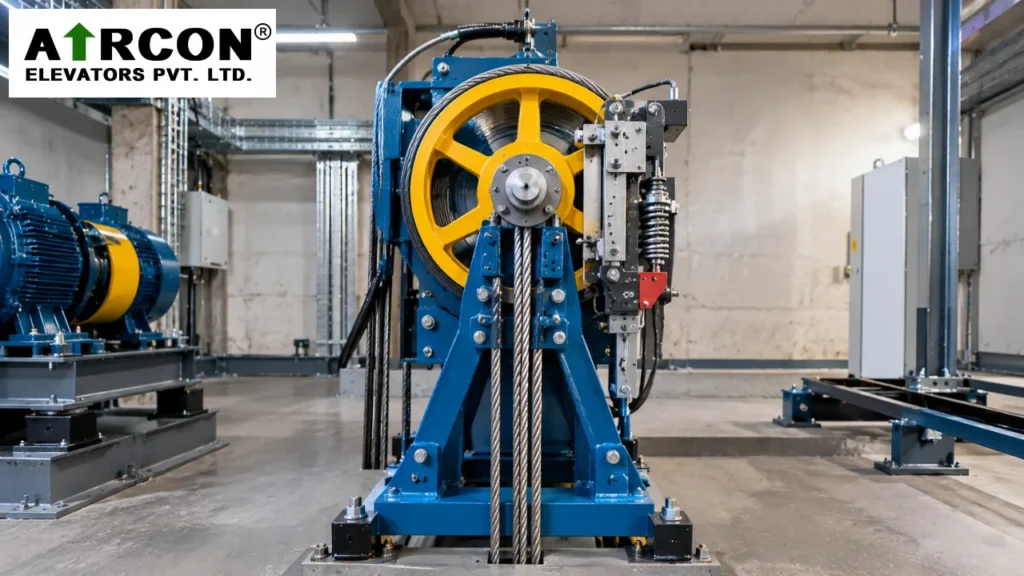
Elevator safety depends on several mechanical and electrical systems working together, and the elevator overspeed governor is one of the most important because it continuously monitors the elevator’s speed during operation. Under normal conditions, passengers never notice its presence, yet it plays a vital role whenever the lift experiences an abnormal increase in speed. Modern traction elevators use an independent governor to monitor overspeed and trigger the safety gear before the cabin reaches an unsafe condition.
Unlike the drive motor or controller, the governor has only one primary responsibility: monitoring elevator speed. If the cabin exceeds its preset speed limit, the governor activates the elevator safety system to help bring the lift under control.
In this guide, you’ll learn what an elevator governor is, how it works, the different types available, testing methods, maintenance tips, and why it remains one of the most critical safety devices in modern elevators.
What Is an Elevator Overspeed Governor?
An elevator governor is a mechanical safety mechanism that continuously tracks the elevator cabin’s operating speed and reacts whenever it detects unsafe overspeed conditions. It operates independently from the main driving machine and constantly checks whether the lift is moving within its permitted speed range.
If the cabin begins travelling faster than the permitted limit, the governor immediately activates the safety gear beneath the elevator cabin to control the situation. This action helps stop uncontrolled movement before it can become dangerous.
Simply put, the governor acts as the elevator’s speed watchdog. It doesn’t move the lift—it simply watches the cabin’s speed and responds whenever abnormal conditions arise.
Why Is an Elevator Overspeed Governor Important?
Although overspeed situations are uncommon, elevator manufacturers still install governors because they provide an additional layer of protection during emergencies.
Some major benefits include:
- Continuously monitors elevator speed.
- Detects overspeed conditions automatically.
- Activates the elevator safety gear when required.
- Helps protect passengers during emergency situations.
- Reduces the possibility of severe mechanical damage.
- Supports reliable and safe elevator operation.
Without a properly functioning governor, the elevator would lose one of its most important independent safety mechanisms.
How Does an Elevator Overspeed Governor Work?
The working principle of an elevator governor is based on continuous speed monitoring and mechanical activation.
Step 1: Elevator Starts Travelling
Whenever the elevator cabin starts travelling, the governor rope moves with it, causing the governor pulley to rotate continuously throughout the journey.
Step 2: Governor Monitors Cabin Speed
Throughout the journey, the governor compares the cabin’s travelling speed with its preset operating limit.
Step 3: Overspeed Is Detected
If the elevator exceeds the permitted speed because of a malfunction or another abnormal condition, the governor mechanism trips automatically.
Step 4: Safety Gear Activates
When the governor reaches its tripping speed, it tightens the governor rope and transfers mechanical force to the cabin’s safety gear, allowing it to engage automatically. The safety gear then grips the elevator guide rails to stop the cabin safely.
Step 5: Elevator Stops Safely
After the safety gear engages, the cabin comes to a controlled stop, allowing qualified technicians to inspect the elevator before it returns to service.
Main Components of an Elevator Overspeed Governor
Although manufacturers may use different governor designs, the basic components remain almost the same. Each part performs a specific function to ensure accurate speed monitoring and dependable safety operation.
Governor Pulley
The governor pulley rotates continuously as the elevator travels. It works together with the governor rope to monitor the cabin’s movement throughout its journey.
Governor Rope
A high-strength steel governor rope connects the governor assembly to the elevator cabin. Whenever the governor detects overspeed, this rope transfers the mechanical force needed to activate the safety gear.
Unlike the main hoisting ropes, the governor rope is dedicated only to the elevator’s safety system and does not support the cabin’s weight.
Tripping Mechanism
The tripping mechanism is the heart of the governor. It constantly compares the elevator’s travelling speed with its preset limit.
If the speed exceeds the allowable value, this mechanism immediately locks the governor pulley and triggers the safety gear.
Tension Device
A tension device keeps the governor rope properly stretched at all times. Maintaining correct rope tension allows the governor to detect speed accurately and respond without delay.
Governor Switch
Modern governors also include an electrical safety switch.
When the governor trips, this switch sends a signal to the elevator controller, which immediately stops the driving machine and disconnects power to prevent further movement.
Together, these components create a reliable mechanical and electrical safety system that operates independently from the elevator’s normal control functions.
Types of Elevator Overspeed Governors
Different elevator systems use different governor designs depending on travel speed, building height, and safety requirements.
1. Centrifugal Governor
The centrifugal governor is the most widely used type in modern traction elevators.
It uses rotating flyweights that move outward as speed increases. If the cabin exceeds the preset speed, the flyweights activate the tripping mechanism, causing the governor to engage the safety gear.
Because of its simple construction and dependable performance, manufacturers commonly install this design in residential, commercial, and office elevators.
2. Instantaneous Governor
An instantaneous governor reacts immediately once the elevator crosses its overspeed setting.
Instead of slowing the cabin gradually, it quickly activates the safety gear to stop elevator movement.
Manufacturers generally use this type in low-speed elevators because it provides a safe and immediate stop.
3. Progressive Governor
Manufacturers commonly use progressive governors in medium-speed and high-speed elevators.
Rather than stopping the cabin abruptly, they activate progressive safety gear, allowing the elevator to decelerate more smoothly before coming to a complete stop.
This controlled braking reduces passenger discomfort while protecting important elevator components from excessive mechanical stress.
4. Electronic Governor Monitoring Systems
Many modern elevators combine traditional mechanical governors with electronic monitoring systems.
These systems continuously monitor operating conditions and provide additional fault information to the elevator controller. However, the mechanical governor remains the primary overspeed protection device.
Where Is the Elevator Governor Installed?
Manufacturers usually install the governor assembly inside the machine room or at the top of the elevator shaft, depending on the elevator design.
Its governor rope runs vertically through the shaft and connects directly to the elevator cabin and tension device.
Typical installation locations include:
- Near the traction machine in machine-room elevators.
- At the top of the shaft in machine room-less (MRL) elevators.
- Along the governor rope path extending to the cabin.
- Connected to the cabin safety gear through a dedicated linkage mechanism.
This arrangement allows the governor to monitor cabin movement continuously while remaining completely independent of the elevator’s normal lifting system.
How Is an Elevator Governor Tested?
Routine testing ensures that the governor can respond correctly during an emergency.
Qualified elevator technicians normally perform the following inspections:
- Verify the governor’s tripping speed.
- Check the condition of the governor rope.
- Inspect pulley rotation for smooth movement.
- Confirm correct operation of the governor safety switch.
- Test the safety gear activation mechanism.
- Reset the governor after completing the inspection.
Regular testing helps identify worn or damaged components before they affect elevator safety.
Frequently Asked Questions (FAQs)
An elevator overspeed governor is a mechanical safety device that continuously monitors the elevator’s traveling speed. If the cabin exceeds the permitted speed limit, the governor activates the safety system and helps bring the elevator to a controlled stop.
Yes. Nearly all modern traction passenger elevators include an overspeed governor because it is one of the essential safety devices required for safe elevator operation.
Not directly. The governor detects excessive speed and activates the safety gear, which grips the guide rails and safely stops the elevator cabin.
Qualified elevator technicians should inspect and test the overspeed governor during scheduled preventive maintenance. They should also perform detailed testing according to the manufacturer’s recommendations and applicable safety regulations.
Some common warning signs include:
Frequent safety trips
Unusual noise from the governor assembly
Governor rope wear
Cabin speed irregularities
Failure during safety testing
If you notice any of these warning signs, arrange a professional elevator inspection as soon as possible to identify and resolve the underlying problem safely.
Conclusion
The elevator overspeed governor is one of the most important mechanical safety devices found in modern elevators. By continuously monitoring cabin speed and activating the safety gear whenever excessive speed is detected, it helps protect passengers, elevator equipment, and the entire lift system.
Routine inspections, proper lubrication, accurate governor rope tension, and periodic safety testing keep this device ready to perform reliably whenever an emergency occurs. Whether the elevator serves a residential building, commercial complex, hospital, or industrial facility, a properly maintained overspeed governor plays a vital role in delivering safe and dependable operation every day.