
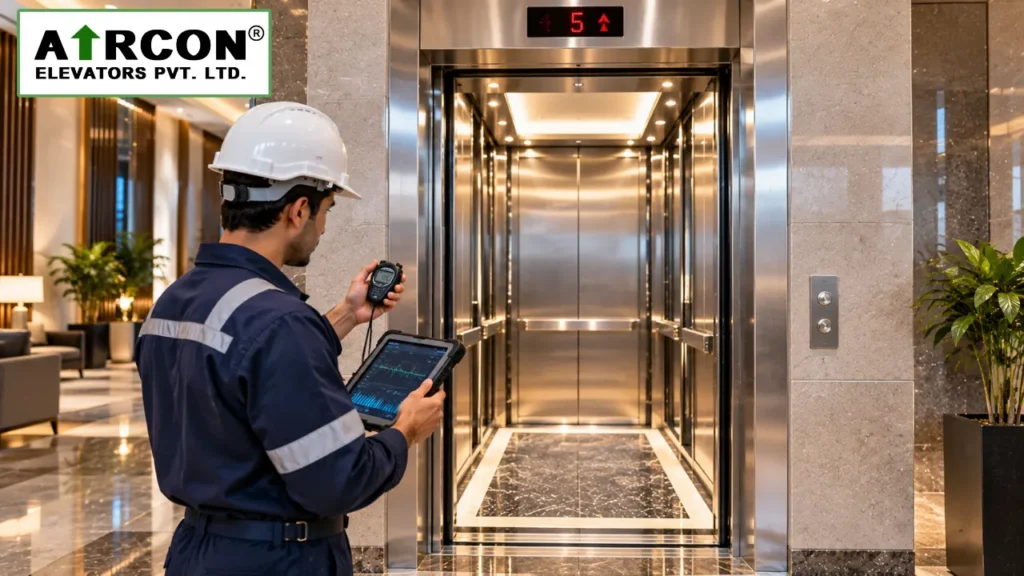
Have you ever wondered how long an elevator should take to travel between floors? Whether you’re installing a home elevator, using a commercial lift, or planning a new building, understanding elevator travel time helps you evaluate performance, passenger comfort, and system efficiency.
However, many people assume that all elevators travel at the same speed. In reality, lift travel time depends on several factors, including the type of elevator, travel distance, motor technology, building height, door operation, passenger load, and controller programming.
For example, a home elevator moving between two floors may take around 20–30 seconds from door opening to door opening, while a high-speed commercial elevator can travel dozens of floors in less than a minute.
Additionally, understanding what affects travel time can also help identify potential maintenance problems. If your elevator suddenly takes much longer than usual, it could indicate issues with the motor, controller, brakes, power supply, or other components.
In this complete guide, we’ll explain how elevator travel time is calculated, what influences it, typical travel times for different elevator types, and how to improve overall elevator performance.
What Is Elevator Travel Time?
Elevator travel time refers to the total time required for an elevator to move from one floor to another under normal operating conditions.
However, many people mistakenly believe travel time only includes the period during which the elevator is moving. In reality, the total travel time begins when the elevator receives a call and ends when the doors fully open at the destination floor.
A complete elevator journey generally includes:
- Door closing time
- Motor acceleration
- Constant-speed travel
- Deceleration before stopping
- Accurate floor leveling
- Door opening time
Because all of these stages take time, the total passenger experience is usually longer than the cabin’s actual moving time.
Why Is Lift Travel Time Important?
Although a few extra seconds may not seem significant, elevator travel time has a major impact on passenger convenience, building efficiency, and traffic management.
A well-designed elevator system provides:
- Faster passenger movement
- Reduced waiting times
- Better building traffic flow
- Improved user experience
- Higher building value
- Greater energy efficiency
As a result, for commercial buildings, hospitals, hotels, and shopping malls, even small improvements in travel time can significantly reduce congestion during peak hours.
Likewise, homeowners appreciate elevators that provide smooth, comfortable, and efficient transportation without unnecessary delays.
How Is Elevator Travel Time Calculated?
Instead, elevator manufacturers don’t simply measure the cabin’s speed. Instead, they evaluate the complete operating cycle.
Specifically, a simplified calculation includes:
Total Travel Time = Door Closing + Acceleration + Full-Speed Travel + Deceleration + Floor Leveling + Door Opening
For example:
- Door closes → 3 seconds
- Acceleration → 2 seconds
- Travel between floors → 5 seconds
- Deceleration → 2 seconds
- Floor leveling → 1 second
- Door opens → 3 seconds
Total travel time = approximately 16 seconds
Therefore, this explains why two elevators with identical maximum speeds can still have different overall travel times.
What Determines Travel Time?
In general, several engineering factors influence how quickly an elevator completes each trip.
The most important factors include:
- Elevator speed
- Building height
- Number of stops
- Motor technology
- Drive system
- Door opening and closing speed
- Passenger load
- Controller programming
- Elevator type
- Floor leveling accuracy
- Traffic conditions
Together, each of these factors plays a role in determining how efficiently the elevator operates.
Does Elevator Speed Always Mean Faster Travel Time?
Not necessarily.
However, many people believe that installing a faster motor automatically reduces travel time. However, maximum speed is only one part of the equation.
In fact, for shorter buildings, elevators often spend more time accelerating and decelerating than traveling at full speed.
For example:
- A home elevator traveling one floor may never reach its maximum rated speed.
- A high-rise elevator traveling 30 floors spends much more time at full speed.
Therefore, low-rise residential elevators usually focus on smooth ride quality rather than extremely high speeds.
If you’re comparing different systems, it’s also useful to understand the differences between geared vs gearless elevator motors, as motor technology directly affects both speed and efficiency.
Typical Elevator Travel Time by Elevator Type
Although actual performance varies by manufacturer, these general ranges provide a useful comparison.
| Elevator Type | Typical Speed | Approximate Travel Time |
| Home Elevator | 0.15–0.4 m/s | 15–30 seconds (2–3 floors) |
| Hydraulic Elevator | 0.3–1.0 m/s | 20–40 seconds |
| Passenger Elevator | 1–2.5 m/s | 10–25 seconds |
| Commercial Elevator | 1.75–4 m/s | 8–20 seconds |
| High-Speed Elevator | 5–10 m/s | Few seconds per several floors |
However, these values include typical operating conditions and may vary depending on building design, controller settings, and elevator specifications.
What Factors Increase Elevator Travel Time?
In some situations, even a well-designed elevator may take longer than expected if certain conditions affect its operation. Some delays are completely normal, while others may indicate maintenance or performance issues.
Below are the most common factors that increase travel time.
1. Building Height
First, one of the biggest factors affecting elevator travel time is the height of the building.
In taller buildings, elevators travel a greater vertical distance, naturally increasing the total journey time. However, high-rise elevators are usually equipped with more powerful motors and higher operating speeds to compensate for the longer travel distance.
In contrast, residential home elevators typically operate at lower speeds because they only serve a few floors and prioritize passenger comfort over speed.
2. Number of Intermediate Stops
Every additional stop increases travel time.
When an elevator stops at multiple floors, it must:
- Slow down safely
- Level accurately with the floor
- Open the doors
- Allow passengers to enter or exit
- Close the doors
- Accelerate again
Consequently, even if each stop adds only 10–20 seconds, several stops during busy hours can significantly increase the total journey time.
This is one reason why office buildings often use intelligent controllers to reduce unnecessary stops.
3. Door Opening and Closing Speed
Interestingly, many people overlook the impact of elevator doors.
In reality, door operation contributes a significant portion of the total lift travel time.
Every trip includes:
- Door closing
- Safety sensor verification
- Door locking
- Door opening
- Passenger entry and exit
If passengers repeatedly block the doors or the door sensors detect obstacles, the doors reopen automatically, adding several extra seconds to every trip.
Modern elevators use advanced elevator door sensor technologies to improve safety while minimizing unnecessary delays.
4. Elevator Controller Programming
Moreover, the elevator controller is responsible for much more than simply moving the cabin.
It constantly monitors:
- Cabin position
- Travel speed
- Door status
- Safety circuits
- Passenger calls
- Load conditions
Based on this information, the controller determines the safest and most efficient operating speed.
Modern smart elevators use intelligent software algorithms that optimize elevator travel time by grouping passenger requests and reducing unnecessary stops.
If the controller develops a fault or requires recalibration, travel time may increase even though the elevator appears to operate normally.
5. Passenger Load
Passenger weight also affects travel time, although not as dramatically as many people think.
Modern elevators are designed to carry their rated capacity safely without major reductions in performance.
However, when the cabin approaches its maximum load:
- Acceleration may become slightly slower.
- The controller performs additional safety checks.
- The motor works harder during travel.
- The elevator may require slightly longer to reach full speed.
If the elevator becomes overloaded, the controller usually prevents movement until the excess weight is removed.
To learn more, read our guide on lift overload protection.
6. Elevator Type
Likewise, different elevator technologies naturally have different operating speeds.
For example:
Hydraulic Elevators
Hydraulic elevators generally travel at lower speeds because they rely on hydraulic pressure to move the cabin.
They provide:
- Smooth rides
- Quiet operation
- Excellent reliability for low-rise buildings
However, they are usually slower than traction elevators.
If you’d like to understand how they work, read our guide on hydraulic elevators.
Traction Elevators
Traction elevators use an electric motor, steel ropes, and a counterweight.
These systems generally provide:
- Faster travel
- Higher efficiency
- Better performance in taller buildings
- Reduced energy consumption
This is why most commercial buildings use traction elevators instead of hydraulic systems.
7. Floor Leveling Accuracy
Before opening the doors, every elevator must stop precisely level with the floor.
This process is called floor leveling.
Although leveling usually takes only a second or two, it is essential for passenger safety.
Proper floor leveling helps:
- Prevent trips and falls
- Improve wheelchair accessibility
- Reduce wear on door mechanisms
- Provide a smoother passenger experience
If the leveling system becomes inaccurate, the controller may slow the elevator slightly to achieve a more precise stop, increasing overall elevator travel time.
8. Maintenance Condition
Unfortunately, a poorly maintained elevator almost always requires more time to complete each trip.
Common maintenance issues include:
- Dirty guide rails
- Worn rollers
- Insufficient lubrication
- Brake drag
- Misaligned sensors
- Loose electrical connections
These problems increase mechanical resistance and reduce operating efficiency.
Following a regular elevator maintenance checklist helps keep travel time consistent while extending the elevator’s lifespan.
Home Elevator vs Commercial Elevator Travel Time
Quite often, many homeowners compare their residential elevator with the faster elevators found in shopping malls or office buildings.
However, these systems are designed for completely different purposes.
| Feature | Home Elevator | Commercial Elevator |
| Building Height | 2–5 Floors | Multi-story Buildings |
| Typical Speed | Lower | Higher |
| Passenger Capacity | Small | Large |
| Ride Comfort | High Priority | Balanced |
| Daily Usage | Low | Heavy |
| Travel Time | Slightly Longer | Faster |
A home elevator is engineered to provide quiet, smooth, and comfortable transportation rather than maximum speed.
Commercial elevators, on the other hand, are optimized for moving large numbers of passengers quickly during peak traffic hours.
Can Elevator Travel Time Be Improved?
Yes.
Fortunately, many factors affecting elevator travel time can be optimized through proper design, regular maintenance, and modern control technology.
Some effective ways to improve travel time include:
- Performing routine preventive maintenance
- Keeping guide rails clean and properly lubricated
- Updating controller software when recommended
- Replacing worn rollers and brake components
- Maintaining a stable electrical power supply
- Avoiding unnecessary overloading
- Scheduling regular professional inspections
These improvements not only reduce travel time but also enhance passenger comfort, energy efficiency, and long-term system reliability.
What Are the Signs That Elevator Travel Time Is Becoming Abnormal?
Generally, a slight variation in elevator travel time is normal, especially when the elevator carries different loads or stops at multiple floors. However, if the travel time suddenly increases or becomes inconsistent, it could indicate an underlying mechanical or electrical problem.
Watch for these warning signs:
- The elevator takes noticeably longer than usual to reach each floor.
- Travel time changes even when the number of stops remains the same.
- The cabin accelerates or decelerates more slowly than before.
- Doors remain open or closed longer than normal.
- The elevator hesitates before moving.
- The cabin stops roughly or experiences jerky movement.
- Unusual grinding, humming, or scraping noises occur during travel.
- Warning lights or fault messages appear frequently.
If you notice one or more of these symptoms, it is advisable to arrange a professional inspection before the issue worsens.
How Do Professionals Measure Elevator Travel Time?
To ensure accurate results, professional elevator technicians use specialized diagnostic tools instead of relying on visual observation.
A standard inspection typically includes:
- Measuring the total elevator travel time between selected floors.
- Recording acceleration and deceleration times.
- Checking the elevator’s maximum operating speed.
- Inspecting door opening and closing duration.
- Testing floor leveling accuracy.
- Measuring motor performance.
- Reviewing controller fault logs.
- Verifying brake operation.
- Testing the elevator under different load conditions.
These measurements help technicians identify whether the issue is related to the motor, controller, door system, sensors, braking system, or another component.
Can Homeowners Measure Elevator Travel Time?
Yes—but only in a basic way.
Homeowners can perform a simple observation by using a stopwatch or smartphone timer.
For example:
- Stand outside the elevator.
- Press the desired floor button.
- Start the timer when the doors begin to close.
- Stop the timer when the doors fully open at the destination floor.
- Repeat the test several times under similar conditions.
If the recorded elevator travel time varies significantly between identical trips, it may indicate a maintenance issue that requires professional attention.
However, homeowners should never attempt to adjust the controller, drive system, brakes, or other safety-related components themselves.
How to Keep Elevator Travel Time Consistent
Maintaining a consistent elevator travel time is easier than many people think. Regular servicing and proper usage help ensure smooth and reliable operation.
Follow these best practices:
- Schedule preventive maintenance according to the manufacturer’s recommendations.
- Avoid exceeding the elevator’s rated load capacity.
- Keep the elevator pit and machine room clean.
- Ensure a stable electrical power supply.
- Report unusual noises or vibrations immediately.
- Replace worn parts before they fail.
- Keep guide rails properly lubricated.
- Inspect door sensors and door operators regularly.
- Perform periodic controller diagnostics.
Routine maintenance not only improves ride quality but also reduces long-term repair costs and unexpected downtime.
Does Elevator Travel Time Affect Energy Efficiency?
Yes.
An elevator operating with an optimized elevator travel time generally consumes energy more efficiently than one suffering from mechanical resistance or electrical faults.
A well-maintained elevator:
- Reaches its operating speed smoothly.
- Reduces unnecessary motor strain.
- Minimizes braking losses.
- Completes trips more efficiently.
- Extends component lifespan.
Modern Machine Room-Less (MRL) elevators are particularly known for combining efficient performance with reduced energy consumption. If you’d like to learn more, read our guide on Machine Room-Less (MRL) elevators.
Frequently Asked Questions (FAQs)
A normal elevator travel time depends on the elevator type, building height, number of stops, and operating speed. For most residential elevators, a journey between two or three floors typically takes around 15–30 seconds, including door operation.
Not always. Even if an elevator has a higher maximum speed, acceleration, deceleration, floor leveling, and door operation also contribute to the total travel time.
During peak traffic periods, the elevator makes additional stops for passengers, increasing the overall elevator travel time.
Yes. Dirty guide rails, worn rollers, brake drag, poor lubrication, and controller issues can all increase elevator travel time.
Generally, yes. Hydraulic elevators usually operate at lower speeds than traction elevators, making them more suitable for low-rise residential buildings.
Regular maintenance, proper controller calibration, clean guide rails, stable power supply, and avoiding overload conditions all help maintain optimal elevator travel time.
If your elevator suddenly becomes much slower, produces unusual noises, experiences jerky movement, or its elevator travel time increases noticeably, schedule a professional inspection as soon as possible.
Final Thoughts
Understanding elevator travel time helps homeowners, builders, architects, and facility managers evaluate elevator performance more accurately. While the elevator’s rated speed is important, total travel time also depends on door operation, acceleration, deceleration, floor leveling, passenger load, controller programming, and maintenance quality.
A well-designed and properly maintained elevator should provide smooth, safe, and consistent travel without unnecessary delays. If you notice that the elevator travel time has increased compared to normal operation, don’t ignore the warning signs. Early diagnosis often prevents expensive repairs and extends the lifespan of the entire elevator system.
Finally, following routine maintenance schedules and recognized BIS elevator safety standards helps ensure your elevator continues to operate safely, efficiently, and reliably for years to come.