
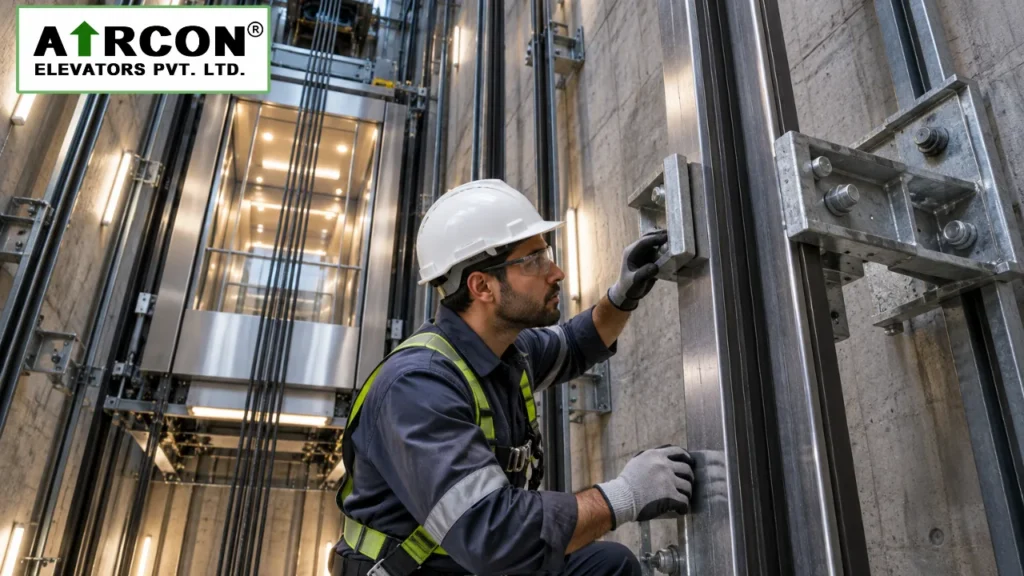
Elevator Guide Rails are one of the most important components responsible for keeping an elevator stable, smooth, and perfectly aligned during travel. Imagine stepping into an elevator on the ground floor of a 20-story building. As the lift begins moving upward, it travels smoothly without shaking, swaying, or drifting from its path because of these precision-engineered guide rails.
The answer lies in one of the most important yet often overlooked components of every elevator system—the Guide Rails.
Installed vertically inside the elevator shaft, guide rails act as precision tracks that direct both the elevator car and the counterweight. They help ensure smooth travel, improve ride comfort, reduce vibration, and provide a secure guiding surface for the elevator’s safety gear during emergency braking. Without properly designed and installed guide rails, an elevator could experience excessive movement, poor ride quality, increased wear on components, and reduced safety.
Whether you’re a homeowner planning to install a home elevator, an architect designing a commercial building, a facility manager, or simply curious about how elevators work, understanding guide rails will help you appreciate one of the most critical parts of modern vertical transportation.
In this guide, we’ll explain how lift guide rails work, the different elevator guide rail types, their functions, materials, and why they are essential for safe and reliable elevator operation.
What Are Elevator Guide Rails?
Lift Guide Rails are rigid steel tracks installed vertically inside the elevator shaft to guide the movement of both the elevator car and the counterweight.
Instead of allowing the elevator cabin to move freely inside the shaft, guide rails keep it traveling along a fixed vertical path. This precise guidance minimizes unwanted side-to-side movement and ensures the elevator remains stable throughout its journey.
Modern lift guide rails are manufactured with high dimensional accuracy and strict tolerances so they can provide smooth operation, even in high-rise buildings and high-speed elevator systems. International standards such as ISO 8100-33 define the dimensional characteristics, quality, and tolerances for standardized T-type guide rails used in passenger and service lifts.
Guide rails are commonly installed in:
- Home Elevators
- Passenger Elevators
- Commercial Lifts
- Hospital Elevators
- Freight & Goods Elevators
- Machine Room Less (MRL) Elevators
- High-Rise Elevators
Why Are Elevator Guide Rails Important?
Many people assume that the suspension ropes alone keep an elevator moving safely.
In reality, suspension ropes lift the elevator, but guide rails control its direction and stability.
Without guide rails, the elevator cabin and counterweight could sway excessively inside the shaft, especially during acceleration, braking, or when strong external forces such as wind or seismic activity affect the building.
Properly installed guide rails provide several important benefits:
- Maintain accurate vertical movement
- Improve passenger comfort
- Reduce cabin vibration
- Minimize operational noise
- Keep the counterweight aligned
- Support emergency braking systems
- Reduce wear on moving components
- Improve long-term elevator reliability
Because of these functions, guide rails are considered one of the most critical structural components in any elevator installation.
How Do Elevator Guide Rails Work?
To understand how guide rails work, imagine railway tracks guiding a train.
Instead of rails on the ground, elevators use precision-engineered steel rails mounted vertically inside the shaft.
Special components called guide shoes or roller guides remain in continuous contact with these rails as the elevator moves.
As the drive machine lifts or lowers the cabin, the guide rails ensure that movement remains perfectly straight and controlled.
The guide rail system performs several tasks simultaneously:
- Guides the elevator car vertically
- Guides the counterweight
- Limits horizontal movement
- Reduces vibration
- Improves ride quality
- Provides a braking surface for safety gear during emergencies
During normal operation, passengers rarely notice these components because they work silently in the background.
Main Functions of Elevator Guide Rails
Although guide rails appear to be simple steel sections, they perform multiple safety and operational functions.
1. Guide the Elevator Car
The primary function of guide rails is to keep the elevator cabin moving along a precise vertical path.
This prevents excessive swaying while maintaining smooth travel between floors.
2. Guide the Counterweight
Most traction elevators use a counterweight to balance the elevator car.
Separate guide rails keep the counterweight aligned as it moves in the opposite direction of the elevator cabin.
3. Improve Ride Comfort
One reason modern elevators feel smooth is that properly aligned guide rails reduce vibration and unwanted lateral movement.
This creates a quieter and more comfortable ride for passengers.
4. Support Emergency Braking
One of the most important safety functions of lift guide rails is their role during emergency situations.
If the elevator safety gear activates, it grips the guide rails to help stop and secure the elevator car. Guide rails are therefore designed with sufficient strength and surface quality to withstand these braking forces.
5. Reduce Wear on Elevator Components
Proper alignment minimizes unnecessary stress on:
- Guide shoes
- Rollers
- Suspension system
- Door mechanisms
- Counterweight system
This helps extend the overall lifespan of the elevator.
Types of Elevator Guide Rails
Different elevator systems require different elevator guide rail types depending on speed, load capacity, and application.
T-Type Guide Rails
The most common elevator guide rail type used worldwide is the T-type guide rail.
These rails feature a T-shaped cross-section and are widely used in:
- Passenger Elevators
- Commercial Buildings
- High-Rise Buildings
- Hospital Elevators
- Goods Lifts
T-type guide rails provide excellent strength, rigidity, and long-term durability, making them suitable for both elevator cars and counterweights. They are standardized under international specifications such as ISO 8100-33.
Cold-Drawn Guide Rails
Cold-drawn guide rails are manufactured through a cold-forming process that improves dimensional accuracy and surface finish.
These rails are commonly used in:
- Residential Elevators
- Low-Rise Buildings
- Light-Duty Passenger Lifts
Their smooth surface helps reduce guide shoe wear and contributes to quieter operation.
Machined Guide Rails
Machined guide rails undergo additional machining after production to achieve tighter dimensional tolerances.
They are commonly selected for:
- High-Speed Elevators
- Premium Commercial Buildings
- Heavy-Duty Passenger Elevators
- Industrial Applications
Because of their high precision, machined rails provide excellent ride comfort and long-term performance.
Materials Used in Elevator Guide Rails
Most guide rails are manufactured from high-quality structural steel.
The material must provide:
- High strength
- Excellent rigidity
- Wear resistance
- Long service life
- Dimensional stability
Modern guide rails are produced under strict manufacturing standards to ensure they can safely withstand operational loads, emergency braking forces, and long-term continuous use.
Guide Shoes and Elevator Guide Rails: How They Work Together
Guide rails alone cannot keep an elevator perfectly aligned. They work together with specialized components called guide shoes, which remain in continuous contact with the rails throughout the elevator’s travel.
As the lift moves up and down, the guide shoes slide or roll along the guide rails, ensuring that the cabin follows a precise vertical path.
Depending on the elevator type and speed, manufacturers generally use one of two guide shoe designs:
Sliding Guide Shoes
Sliding guide shoes use low-friction liners that glide directly against the guide rails.
They are commonly installed in:
- Home Elevators
- Residential Buildings
- Low-Speed Passenger Elevators
Their simple design makes them reliable, cost-effective, and easy to maintain.
Roller Guide Shoes
Roller guide shoes use precision rollers instead of sliding surfaces.
These rollers rotate smoothly along the guide rails, significantly reducing friction and vibration.
They are commonly used in:
- High-Speed Elevators
- Commercial Buildings
- Hotels
- Office Towers
- Premium Passenger Elevators
Because roller guides provide smoother operation, they greatly improve passenger comfort while reducing operational noise.
How Lift Guide Rails Improve Ride Quality
One of the biggest reasons modern elevators feel smooth is the quality of the lift guide rails.
Even a powerful elevator motor cannot provide a comfortable ride if the guide rail system is poorly aligned.
Properly installed guide rails help:
- Reduce side-to-side movement
- Minimize cabin vibration
- Prevent unwanted swaying
- Improve stopping accuracy
- Reduce operating noise
- Increase passenger comfort
In high-rise buildings, even tiny alignment errors can become noticeable over long travel distances.
This is why guide rail installation is performed with laser alignment tools and strict engineering tolerances.
Role of Elevator Guide Rails During Emergency Braking
One of the most important functions of lift guide rails is supporting the elevator’s emergency braking system.
Modern elevators include several independent safety devices designed to stop the elevator safely if an abnormal condition occurs.
If excessive speed is detected, the elevator’s Safety Gear activates automatically.
Instead of gripping the suspension ropes, the safety gear clamps directly onto the guide rails.
The rails are specifically engineered to withstand these braking forces without deformation.
This design allows the elevator cabin to stop safely while remaining securely guided inside the shaft.
Without strong guide rails, emergency braking systems could not function effectively.
Standard Elevator Guide Rail Sizes
Different elevator applications require different guide rail sizes.
The required size depends on factors such as:
- Elevator speed
- Cabin weight
- Rated load capacity
- Travel height
- Building type
Some of the most commonly used elevator guide rail sizes include:
| Guide Rail Size | Common Application |
| T45/A | Small Home Elevators |
| T50/A | Residential Lifts |
| T70-1/B | Standard Passenger Elevators |
| T75-3/B | Commercial Buildings |
| T89/B | Medium & High-Rise Buildings |
| T114/B | Heavy Passenger Elevators |
| T127-1/B | High-Speed Elevators |
| T140-1/B | Heavy-Duty Commercial Projects |
The exact guide rail specification is selected during the elevator design process to ensure it can safely handle the elevator’s operating conditions.
Passenger Elevator Guide Rails vs Goods Lift Guide Rails
Although both systems perform the same basic function, passenger Lift guide rails and goods lift guide rails are not always identical.
Passenger Lift Guide Rails
Passenger elevators prioritize:
- Ride comfort
- Low vibration
- Quiet operation
- Smooth acceleration
- Precise floor leveling
For this reason, they often use high-precision machined guide rails with tighter installation tolerances.
Goods Lift Guide Rails
Goods elevators focus more on carrying heavy loads than passenger comfort.
These systems generally require:
- Higher load capacity
- Greater structural strength
- Increased rigidity
- Heavy-duty construction
Because industrial goods lifts often transport machinery, pallets, and equipment, their guide rails are designed to withstand significantly higher operating forces.
How Elevator Guide Rails Are Installed
Installing elevator guide rails is a highly precise engineering process.
Even a small alignment error can affect ride quality, increase component wear, and reduce long-term performance.
The installation process generally includes the following steps:
Step 1: Shaft Inspection
Before installation begins, technicians inspect the elevator shaft to ensure:
- Shaft dimensions are correct
- Walls are structurally sound
- Mounting locations are properly prepared
Step 2: Installing Rail Brackets
Heavy-duty steel brackets are securely fixed to the shaft walls at predetermined intervals.
These brackets support the guide rails throughout the shaft height.
Step 3: Positioning the Guide Rails
Individual guide rail sections are carefully lifted into position and connected using fishplates and high-strength bolts.
Each section must align perfectly with the next.
Step 4: Precision Alignment
Using laser alignment equipment and precision measuring tools, technicians verify that the guide rails remain perfectly straight from the pit to the top of the shaft.
This step is critical for achieving smooth elevator operation.
Step 5: Final Inspection
After installation, engineers inspect:
- Rail alignment
- Joint accuracy
- Bracket tightness
- Vertical tolerance
- Surface condition
Only after passing these inspections does the elevator proceed to the next stage of installation.
Factors That Affect Guide Rail Selection
Choosing the correct elevator guide rail type depends on several engineering factors.
Manufacturers consider:
- Rated elevator capacity
- Elevator speed
- Travel height
- Building height
- Passenger traffic
- Cabin dimensions
- Counterweight size
- Type of elevator (Passenger, Home, Goods, Hospital)
- Applicable safety standards
Selecting the correct guide rail specification ensures long-term reliability, improved ride comfort, and safe operation throughout the elevator’s lifespan.
Frequently Asked Questions (FAQs)
Yes. Although elevator guide rails are manufactured from high-strength steel and designed to last for decades, they can experience wear due to continuous operation, poor lubrication, misalignment, or inadequate maintenance. Regular inspections help identify rail wear before it affects ride quality or safety.
Absolutely. Every modern home lift, whether hydraulic, traction, or machine room-less (MRL), uses guide rails to keep both the lift cabin and counterweight moving safely inside the shaft.
Misaligned rails can cause:
Cabin vibration
Unusual noise
Rough ride quality
Faster guide shoe wear
Increased maintenance costs
This is why proper rail installation and periodic alignment checks are essential.
Yes., Passenger elevators prioritize smooth and quiet operation, while goods lifts often require heavier guide rails capable of handling much larger loads and higher structural forces.
During routine maintenance, technicians inspect guide rails for:
Alignment
Corrosion
Loose brackets
Surface wear
Joint accuracy
Guide shoe condition
Commercial elevators generally require inspections more frequently than residential lifts due to higher daily usage.
Final Thoughts
Although passengers rarely notice them, Elevator Guide Rails are among the most important structural components of any lift system. They keep the elevator cabin and counterweight precisely aligned, support smooth vertical travel, and work together with multiple safety systems to maintain stable and reliable operation.
Whether installed in a home elevator, commercial passenger lift, hospital elevator, or industrial goods lift, properly engineered guide rails contribute to ride comfort, equipment longevity, and overall passenger safety.
Choosing high-quality guide rails, ensuring professional installation, and scheduling regular maintenance inspections can significantly improve elevator performance while reducing long-term maintenance costs. As elevator technology continues to evolve, guide rail systems remain a fundamental part of safe and efficient vertical transportation.