
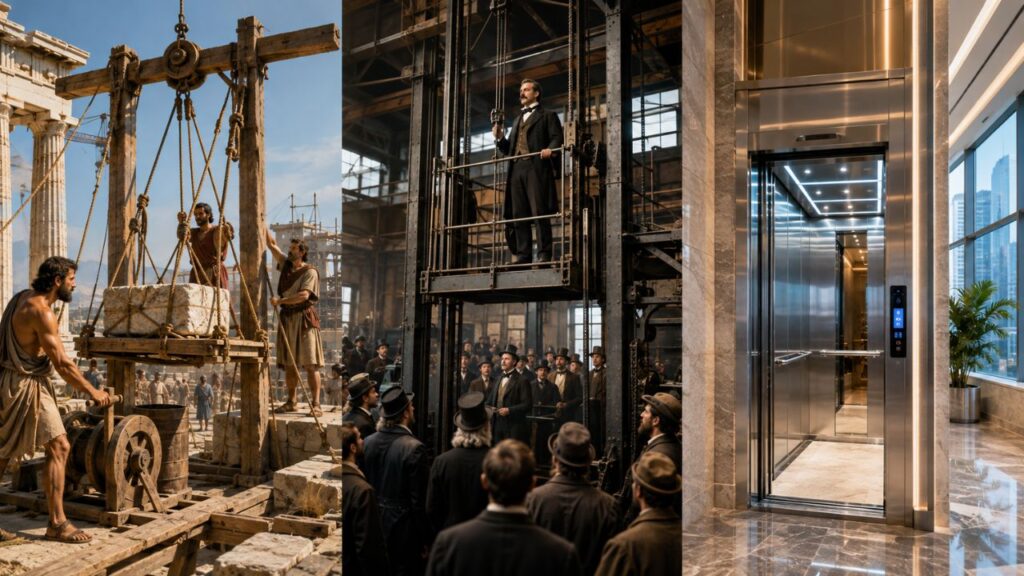
When people ask, “Who invented the elevator?”, the answer isn’t as straightforward as naming one person. The concept of lifting people and heavy materials vertically has existed for thousands of years. Elisha Graves Otis invented the safety mechanism that made elevators safe for everyday passenger use and helped architects build modern skyscrapers.
In this article, we’ll explore the fascinating history of elevators, from ancient lifting devices to today’s intelligent, high-speed elevator systems.
The First Elevator Was Invented Over 2,000 Years Ago
The earliest known elevator-like device dates back to around 236 BC, when the Greek mathematician and inventor Archimedes designed a simple lifting platform using ropes, pulleys, and manual power. It was mainly used to lift goods and construction materials rather than passengers.
These early lifting systems laid the foundation for the vertical transportation technology we use today.
Why Early Elevators Were Not Safe
As civilizations advanced, engineers and inventors created various lifting devices across Europe and other regions, using human effort, animal power, water wheels, and later steam engines to move heavy loads.
However, one major problem remained the lifting ropes could snap without warning. Because of this, elevators were considered too dangerous for transporting people and were mostly used for moving goods in factories, mines, and warehouses.
Elisha Otis Changed Elevator History Forever
The turning point came in 1852, when American inventor Elisha Graves Otis introduced a revolutionary safety braking mechanism.
His invention automatically locked the elevator car in place if the hoisting rope failed, preventing it from falling. This simple but brilliant innovation transformed elevators from risky machines into safe transportation systems for people.
Today, Elisha Otis is widely recognized as the father of the modern passenger elevator.
The Famous Safety Demonstration
In 1854, Elisha Otis publicly demonstrated his invention at the Crystal Palace Exhibition in New York.
Standing on an elevated platform, he instructed an assistant to cut the supporting rope. Instead of crashing to the ground, the platform stopped almost immediately because the safety brake engaged.
This dramatic demonstration convinced people that elevators could be trusted for passenger transportation and marked the beginning of a new era in building design.
The First Passenger Elevator
After Elisha Graves Otis introduced his safety system, a New York City department store installed the world’s first commercial passenger elevator in 1857. This breakthrough transformed architecture forever by allowing architects to design taller buildings without forcing people to rely on long flights of stairs.
As a result, commercial high-rises and modern skyscrapers became a practical reality.
How Elevators Continued to Evolve
After Otis’ breakthrough, elevator technology advanced rapidly.
Some of the biggest innovations included:
- Hydraulic elevator systems
- Electric elevators
- Automatic doors
- Gearless traction machines
- Machine Room Less (MRL) technology
- High-speed elevators
- Smart destination control systems
- Energy-efficient regenerative drives
- AI-enabled monitoring and predictive maintenance
These developments have made elevators faster, quieter, safer, and more energy-efficient than ever before.
Modern Elevators in Today’s Buildings
Today, elevators are an essential part of modern infrastructure. They are used in almost every type of building, including:
- Residential Apartments
- Luxury Villas
- Commercial Offices
- Shopping Malls
- Hospitals
- Hotels
- Airports
- Industrial Plants
- Warehouses
- High-Rise Towers
Modern elevators are designed with multiple safety systems, intelligent controls, and premium cabin interiors to provide a comfortable passenger experience.
The Future of Elevator Technology
The elevator industry continues to evolve with new innovations focused on safety, sustainability, and smart building integration.
Future elevators are expected to include:
- AI-based maintenance monitoring
- IoT-enabled remote diagnostics
- Touchless operation
- Voice-controlled systems
- Energy-saving drive technologies
- Advanced destination dispatch systems
These technologies will further improve efficiency while reducing maintenance costs and energy consumption.
Why Choosing the Right Elevator Manufacturer Matters
While elevator technology has advanced significantly over the centuries, the quality of installation and manufacturing remains just as important.
A trusted manufacturer ensures:
- High-quality engineering
- Advanced safety features
- Smooth operation
- Customized elevator solutions
- Professional installation
- Reliable maintenance support
At Aircon Elevators Pvt. Ltd., we combine modern engineering with industry best practices to manufacture and install customized elevator solutions for residential, commercial, healthcare, and industrial projects across India.
Frequently Asked Questions
The earliest elevator-like device is credited to Archimedes around 236 BC, while Elisha Graves Otis invented the safety mechanism that made modern passenger elevators practical and safe.
He invented the elevator safety brake in 1852, making passenger elevators much safer and enabling the construction of modern skyscrapers.
The first commercial passenger elevator entered service in 1857 in New York City.
Early elevators were primarily used to lift construction materials, goods, and heavy loads rather than passengers.
Modern buildings commonly use passenger elevators, hydraulic elevators, traction elevators, MRL elevators, hospital elevators, goods lifts, automobile elevators, and panoramic elevators.
The history of elevators is a story of continuous innovation. While early lifting systems date back to ancient civilizations, Elisha Graves Otis transformed the industry by introducing a safety mechanism that made passenger elevators reliable and practical. His invention not only changed the way people moved within buildings but also made the modern skyline possible.
Today, companies like Aircon Elevators Pvt. Ltd. continue that legacy by delivering advanced, safe, and customized elevator solutions that meet the needs of modern homes, commercial buildings, hospitals, industries, and high-rise developments.