
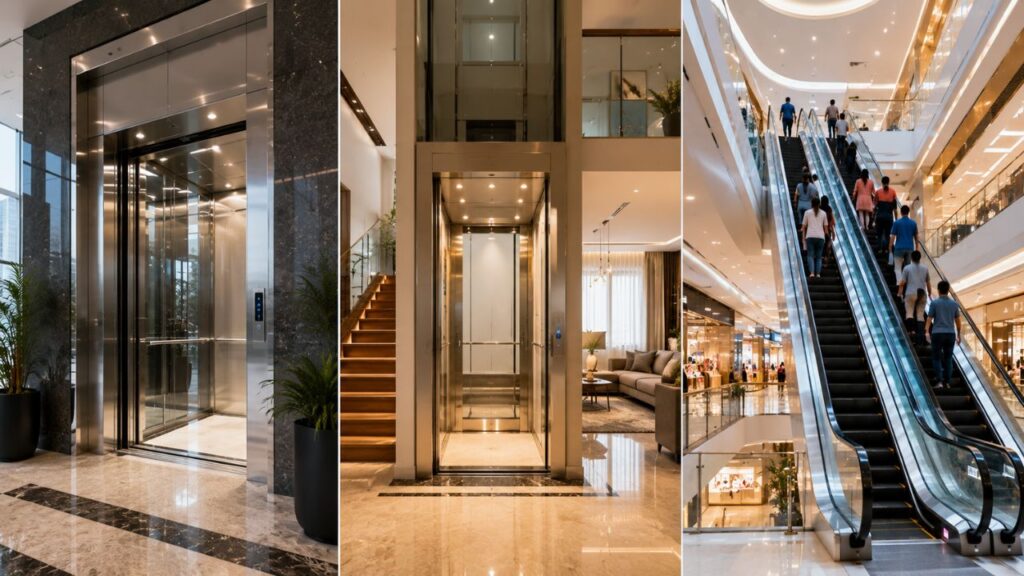
If you’re planning a residential, commercial, or industrial building, you’ve probably come across the terms lift, elevator, and escalator. While many people use these words interchangeably, they actually refer to different types of vertical transportation systems.
Understanding the difference helps builders, architects, business owners, and homeowners choose the most suitable solution based on building type, passenger traffic, available space, and budget.
In this guide, we’ll explain how lifts, elevators, and escalators differ, where each system is commonly used, and which option is best for your project.
What Is a Lift?
The word lift is widely used in India, the UK, Australia, and many other countries. It refers to an enclosed cabin that moves people or goods vertically between floors.
A lift travels inside a dedicated shaft and is operated using buttons or a control panel. Depending on the application, lifts can carry passengers, stretchers, vehicles, or industrial materials.
Common Applications
- Residential Buildings
- Apartments
- Villas
- Offices
- Hospitals
- Hotels
- Warehouses
- Factories
What Is an Elevator?
An elevator performs the same function as a lift. The primary difference is the terminology rather than the technology.
The word elevator is more commonly used in the United States and Canada, while lift is the preferred term in countries like India and the UK.
Modern elevators are available in several configurations, including:
- Passenger Elevators
- Home Elevators
- Goods Elevators
- Hospital Elevators
- Capsule Elevators
- Hydraulic Elevators
- Machine Room Less (MRL) Elevators
From a technical perspective, there is no functional difference between a lift and an elevator—only the regional name changes.
What Is an Escalator?
An escalator is a continuously moving staircase designed to transport people between different floor levels.
Unlike lifts and elevators, escalators remain in constant motion and can accommodate a continuous flow of passengers without waiting for a cabin.
Escalators are commonly installed in places with heavy foot traffic.
Common Applications
- Shopping Malls
- Metro Stations
- Airports
- Railway Stations
- Large Commercial Buildings
- Exhibition Centres
They are not intended for transporting heavy goods or people using wheelchairs unless alternative accessibility solutions are available.
Lift vs Elevator vs Escalator: Quick Comparison
| Feature | Lift | Elevator | Escalator |
| Purpose | Vertical Transport | Vertical Transport | Moving Staircase |
| Passenger Cabin | Yes | Yes | No |
| Continuous Movement | No | No | Yes |
| Best For | Homes, Offices, Hospitals | Commercial & Residential Buildings | Malls, Airports, Metro Stations |
| Carries Goods | Yes | Yes | No |
| Wheelchair Friendly | Yes | Yes | Limited |
| Requires Lift Shaft | Yes | Yes | No Lift Shaft |
Which Option Is Best for Your Building?
Choose a Lift or Elevator If:
- Your building has multiple floors.
- You need to transport elderly people or wheelchair users.
- Goods or equipment need to be moved safely.
- Accessibility is a priority.
- Space is available for a lift shaft.
Choose an Escalator If:
- The building receives thousands of visitors every day.
- Passenger movement needs to be continuous.
- Shopping malls, airports, or metro stations are being designed.
- Short waiting times are important.
Factors to Consider Before Choosing
Before selecting a vertical transportation system, evaluate:
- Building purpose
- Number of floors
- Daily passenger traffic
- Accessibility requirements
- Available installation space
- Budget
- Maintenance requirements
- Future expansion plans
A professional consultation helps determine the most suitable solution for your project.
Why Choose Aircon Elevators Pvt. Ltd.?
Aircon Elevators Pvt. Ltd. manufactures high-quality elevator solutions for residential, commercial, healthcare, and industrial applications across India.
Our product range includes:
- Passenger Elevators
- Home Elevators
- Goods & Freight Lifts
- Hospital Elevators
- Capsule Elevators
- Hydraulic Elevators
- MRL Elevators
- Automobile Elevators
- Elevator Modernization
- Annual Maintenance Contracts (AMC)
Our team provides complete support from design and manufacturing to installation and after-sales service.
Frequently Asked Questions
Yes. A lift and an elevator perform the same function. The difference lies mainly in regional terminology “lift” is commonly used in India and the UK, while “elevator” is the preferred term in North America.
An elevator uses an enclosed cabin to move passengers or goods vertically, whereas an escalator is a moving staircase designed for continuous pedestrian movement.
Shopping malls typically use both systems. Escalators handle continuous customer movement, while elevators provide accessibility for families, elderly people, wheelchair users, and goods transportation.
No. Escalators cannot replace elevators because they are not suitable for transporting wheelchairs, heavy goods, stretchers, or people with limited mobility.
A passenger elevator or home lift is the ideal solution for residential buildings because it offers safe, comfortable, and convenient access between floors.
Although the terms lift and elevator are often used interchangeably, they describe the same type of vertical transportation system. An escalator, on the other hand, serves a different purpose by providing continuous movement for large numbers of pedestrians.
Choosing the right solution depends on your building’s design, traffic flow, accessibility needs, and available space. Whether you’re constructing a residential property, office complex, hospital, or commercial facility, selecting the appropriate system will improve convenience, safety, and long-term efficiency.
If you’re looking for reliable elevator solutions in India, Aircon Elevators Pvt. Ltd. offers customized products, professional installation, and dependable maintenance services tailored to your project requirements.