
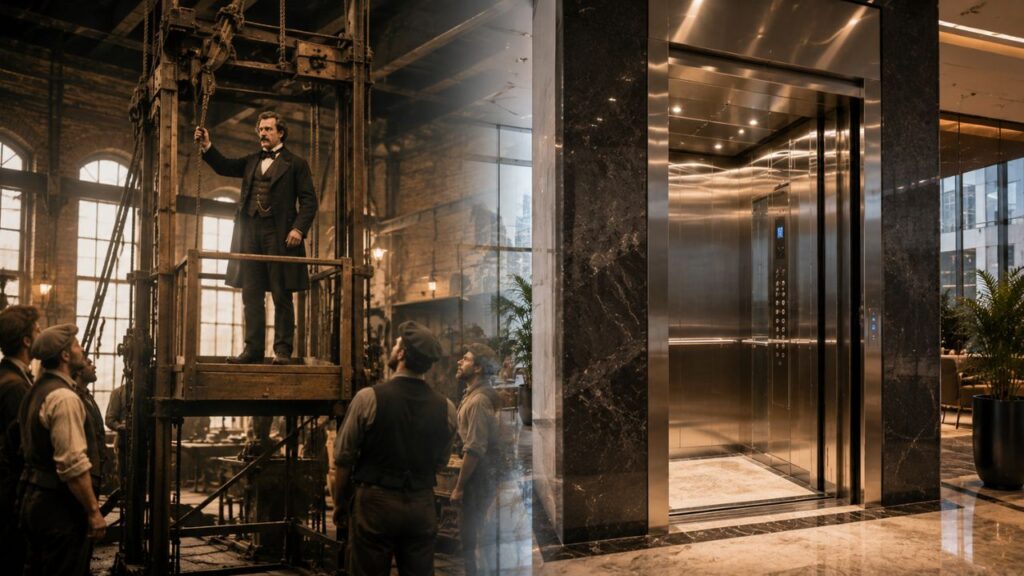
When we step into an elevator today, we rarely think about the engineering innovations that make every journey safe and reliable. Modern elevators are equipped with advanced safety systems, intelligent controls, and precision engineering, allowing millions of people to travel between floors with confidence every day.
However, the story of safe vertical transportation began more than 170 years ago with one remarkable inventor Elisha Otis. His groundbreaking safety mechanism transformed elevators from risky lifting platforms into dependable transportation systems, laying the foundation for the skyscrapers and modern cities we know today.
At Aircon Elevators Pvt. Ltd., we believe understanding this history helps people appreciate how far elevator technology has evolved and why safety continues to be the most important aspect of every elevator we manufacture.
Who Was Elisha Otis?
Elisha Graves Otis was an American inventor and industrial engineer best known for developing the first practical elevator safety brake in the early 1850s.
Before his invention, elevators were already being used to lift goods in factories and warehouses. However, they were considered dangerous because if the lifting rope snapped, the platform could fall freely, often resulting in serious accidents.
Recognizing this major safety concern, Elisha Otis designed a mechanical safety device that automatically locked the platform in place if the hoisting rope failed. His invention changed public perception of elevators forever and opened the door to safer passenger transportation.
The Problem with Early Elevators
Long before high-rise buildings became common, lifting platforms were mainly used for transporting heavy materials.
The biggest challenge was simple but serious there was no dependable protection against a broken lifting rope.
Because of this risk:
- Passenger elevators were rarely trusted.
- Tall buildings remained uncommon.
- Property owners hesitated to install elevators.
- Public confidence in vertical transportation was very low.
Without a reliable safety mechanism, elevators could never become a practical solution for everyday use.
The Invention That Changed Everything
Elisha Otis solved this challenge by creating a safety brake that automatically engaged whenever the lifting rope lost tension.
Instead of allowing the platform to fall, the safety device locked it securely onto the guide rails.
This innovation completely changed the future of elevator engineering because it proved that elevators could be made significantly safer for transporting people.
The concept of automatic safety intervention remains one of the most important principles in elevator engineering even today.
The Famous Public Demonstration
One of the most memorable moments in elevator history occurred when Elisha Otis publicly demonstrated his invention.
Standing on a raised lifting platform before a large audience, he instructed workers to cut the supporting rope. Instead of crashing to the ground, the platform stopped almost instantly as the safety mechanism engaged.
The dramatic demonstration convinced architects, builders, and business owners that elevators could be trusted for passenger transportation.
This single event helped accelerate the adoption of elevators in commercial buildings around the world.
How Elisha Otis Changed Modern Architecture
Safe elevators made it practical to construct taller buildings.
Before reliable elevators, climbing multiple flights of stairs limited how high buildings could realistically grow. After safer elevator systems became available, architects gained the confidence to design multi-storey offices, hotels, hospitals, and residential towers.
Today, elevators are an essential part of:
- High-rise Apartments
- Commercial Office Buildings
- Shopping Malls
- Hotels
- Hospitals
- Airports
- Industrial Facilities
- Educational Institutions
Modern cities would look very different without this breakthrough in elevator safety.
How Elevator Technology Has Evolved
Although the basic goal remains the same moving people safely between floors elevator technology has advanced tremendously since Elisha Otis introduced his safety brake.
Today’s elevators combine mechanical engineering with intelligent electronics to provide smoother, faster, and more energy-efficient operation.
Modern innovations include:
- Gearless Drive Systems
- Machine Room Less (MRL) Technology
- Variable Frequency Drives (VVVF)
- Automatic Rescue Devices (ARD)
- Intelligent Group Control Systems
- Energy-Efficient LED Lighting
- Touchless Controls
- Smart Monitoring Systems
- Precision Floor Levelling
These advancements improve passenger comfort while maintaining high safety standards.
Safety Features Used in Modern Elevators
Today’s elevators incorporate multiple layers of protection rather than relying on a single safety mechanism.
Common safety features include:
- Automatic Rescue Device (ARD)
- Door Interlock System
- Overload Protection
- Emergency Alarm
- Emergency Lighting
- Speed Governor
- Safety Gear Assembly
- Buffer Systems
- Door Sensors
- Automatic Braking Systems
These technologies work together to help ensure smooth and reliable operation under normal and emergency conditions.
Continuing the Legacy at Aircon Elevators
The invention of Elisha Otis established an important principle that still guides the elevator industry today safety must always come first.
At Aircon Elevators Pvt. Ltd., this philosophy is reflected in every stage of our work. From engineering and manufacturing to installation and after-sales support, we focus on delivering elevators that combine safety, performance, and long-term reliability.
Our product range includes:
- Passenger Elevators
- Residential Home Lifts
- Hospital & Stretcher Elevators
- Goods & Freight Elevators
- Capsule Elevators
- Hydraulic Elevators
- Automobile Elevators
- Observation Elevators
- Industrial Lift Solutions
Each project is customized according to the building’s requirements, ensuring efficient operation and dependable performance.
Why Elevator Safety Still Matters
Modern buildings depend heavily on elevators. Offices, hospitals, shopping centres, hotels, and residential towers rely on them every day.
Choosing a well-designed elevator and maintaining it regularly helps provide:
- Reliable daily operation
- Greater passenger confidence
- Reduced downtime
- Improved accessibility
- Longer equipment life
- Better building efficiency
Regular inspections, preventive maintenance, and timely modernization also play an important role in maintaining elevator performance over the years.
Frequently Asked Questions
Elisha Otis was an American inventor who developed the first practical elevator safety brake, making passenger elevators much safer and more reliable.
His safety mechanism helped prevent elevator platforms from falling if the lifting rope failed, encouraging the widespread use of elevators in multi-storey buildings.
No. Elevating devices existed before his work. His major contribution was inventing a practical safety brake that made passenger elevators commercially viable.
Modern elevators now use advanced drive systems, intelligent controllers, Automatic Rescue Devices (ARD), energy-efficient motors, and multiple safety systems to improve performance and passenger safety.
Aircon Elevators manufactures customized elevator solutions using advanced engineering, modern safety features, quality components, and professional installation practices for residential, commercial, hospital, and industrial applications.
The history of modern elevators cannot be discussed without recognizing Elisha Otis. His safety brake transformed elevators from a risky lifting mechanism into a trusted mode of transportation, making today’s high-rise buildings possible.
More than a century later, the elevator industry continues to build on the same principle: innovation should always improve safety. At Aircon Elevators Pvt. Ltd., we carry that vision forward by designing customized elevator solutions that combine advanced technology, dependable performance, and a commitment to passenger safety for every project.